Get Full Government Meeting Transcripts, Videos, & Alerts Forever!
Get email alerts on the Biotech Research And Medical Education topic
No spam. Unsubscribe anytime.
University of Minnesota and Mayo Clinic brief Senate committee on state-funded research and medical-training partnerships
Summary
University of Minnesota and Mayo Clinic officials described the Minnesota Partnership for Biotechnology and Medical Genomics and how state appropriations support research commercialization, medical training and residency programs; committee members asked about funding sources and program metrics.
Officials from the University of Minnesota and the Mayo Clinic presented to a Senate committee on the Minnesota Partnership for Biotechnology and Medical Genomics and on how state appropriations support medical education and residency programs.
Peter Crawford, vice dean for research at the University of Minnesota Medical School, described the Minnesota Partnership for Biotechnology and Medical Genomics (a collaboration among the University of Minnesota, the Mayo Clinic and the state formed in 2003). Crawford said the partnership has distributed about $167 million competitively to 279 research and infrastructure projects over two decades and that nearly $43.9 million of that total has been allocated to Alzheimer's disease and related-dementia research. He said the program has helped spin out 22 startup innovations and that 16 have reached clinical trials or clinical stages; seven projects have reached real-world use.
Crawford and Vyas Prakash of Mayo Clinic outlined examples of partnership-supported innovations, including a bioengineered transcatheter aortic valve later licensed to a Minnesota startup; next-generation methods for clinical microbiome analysis licensed to CoreBiome; an ultra-small wireless radiation sensor licensed to VOXI Health; improved field treatment tools for tension pneumothorax that provide visual confirmation in noisy environments; and a cell-reprogramming therapy for Duchenne muscular dystrophy that advanced to an FDA investigational new drug application and clinical trial after partnership support.
Prakash described the joint program-management structure, peer review and financial oversight that both institutions use for project selection and post-award monitoring. He said projects are tracked for five years after closeout to measure outcomes such as publications, follow-on funding, licenses and company formation.
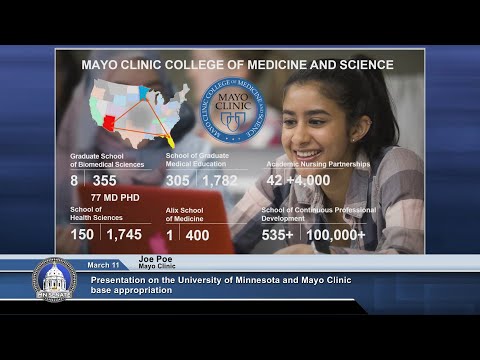
Mayo Clinic presenters John Poe and Dave Dolan then described how state appropriations for Mayo Clinic College of Medicine and Science are allocated. Dolan said the appropriation aids Minnesota residents attending the Mayo Clinic Alix School of Medicine (noting a small number of recipients each year, roughly 16 to 18 students) and supports family medicine residency slots in Rochester and Mankato. Dolan said 67% of a recent small cohort of Mayo-funded medical-school graduates entered primary-care residencies and that the family-medicine residency funding helps pay resident salaries and benefits; the Mankato residency was noted as having a higher share of graduates who practice in greater Minnesota.
Committee questions focused on funding sources and indirect costs. Crawford said the partnership's funded projects are "self contained" and that more than 98% of funds go directly to research activities; he confirmed institutions allocate facilities and administration costs consistent with NIH rates. Senator Clark asked for clarification about indirect costs and program fluctuations; Mayo representatives said class sizes and the highly selective Alix School of Medicine cause year-to-year variation in numbers of Minnesota recipients.
Presenters said the partnership and institutional investments aim to produce both health and economic returns: translating discoveries into clinical use and commercial products while training medical professionals who may practice in Minnesota.
Committee members had no further action; the presentations were received for the record.