Minnesota municipal, county and trade groups urge robust 2025 bonding bill to address water, roads and bridges
Loading...
Summary
Testimony to the Minnesota Senate Capital Investment Committee on the need for a 2025 capital investment (bonding) bill stressed the urgency of funding water and wastewater upgrades, local roads and bridges, wetland replacement, transit facilities, and state asset preservation.
Testimony to the Minnesota Senate Capital Investment Committee on the need for a 2025 capital investment (bonding) bill stressed the urgency of funding water and wastewater upgrades, local roads and bridges, wetland replacement, transit facilities, and state asset preservation.
Craig Johnson, senior intergovernmental relations representative for the League of Minnesota Cities, told the committee the League represents almost all Minnesota cities and highlighted the breadth of municipal capital needs. "The state of Minnesota has 8 56 cities, 8 41 of those are now members of the League of Minnesota Cities, we have 15 that are not," Johnson said, adding that cities rely on state partnership to meet infrastructure needs.
Why it matters: Committee members heard that delayed bonding makes some projects more expensive, risks federal matching funds, and pushes costs onto local taxpayers. Speakers argued that regular, predictable bonding bills support public health and safety, economic development and family-supporting jobs.
Committee testimony described several high‑priority program areas. Emily Murray, policy analyst for the Association of Minnesota Counties, emphasized the local government road wetland replacement program overseen by the Board of Water and Soil Resources (BWSR) and said "Minnesota law requires the Board of Water and Soil Resources to oversee the replacement of wetlands." Murray said five of the state's wetland bank service areas have less than one year of capacity and that workgroup recommendations include a mix of operating and capital funding; she said Senate File 1535 being advanced by several senators would include $15,000,000 in GO bonds and $11.5 million in one‑time general fund cash to sustain the program and recommended an ongoing need of about $9.5 million per year.
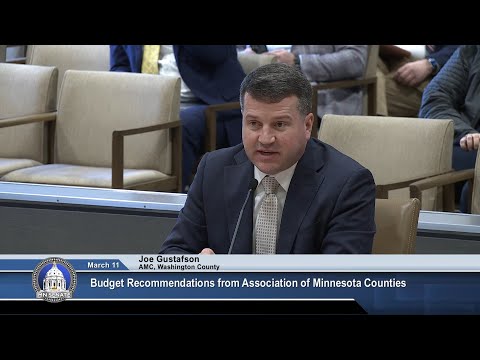
Joe Gustafson, Washington County traffic engineer representing Minnesota County Engineers Association members, gave specific program statistics for local road programs. He said the Local Road Improvement Program (LRIP) had $103 million available during a recent solicitation but generated 378 applications requesting $417 million; 86 projects were selected. Gustafson said the total construction cost for the submitted projects was about $922 million, meaning LRIP funds would cover roughly 45% of costs when leveraged with local and federal dollars.
Water and wastewater funding was another recurring theme. Bradley Peterson of the Coalition of Greater Minnesota Cities cited a Minnesota Department of Health and MPCA analysis estimating $16.7 billion in drinking water and wastewater needs over the next 20 years, and said his coalition supports Senate File 862, "which would provide a total of $299,000,000 to the Public Facilities Authority (PFA) to address these critical needs." Several speakers urged higher grant caps to reflect rising project costs.
Environmental groups framed the investments as critical to public health. "I'm here because of two words, clean water," Nels Paulson, policy director for Conservation Minnesota, said, adding that investments in drinking water infrastructure and municipal wastewater treatment protect both human health and downstream lakes and rivers. Paulson repeated that replacing all lead service lines remains a priority and cited an estimated statewide replacement cost between $1 billion and $2 billion.
Speakers also asked the committee to consider transportation funding mechanisms beyond general obligation bonds. Margaret Donahoe, executive director of the Minnesota Transportation Alliance, urged both a large GO bonding bill and authorization of additional trunk highway bonds supported by the trunk highway fund, saying MnDOT projections show capacity to support over $600 million in additional trunk‑highway bonding. Donahoe and others noted uncertainty at the federal level and the potential for paused discretionary grants under the Infrastructure Investment and Jobs Act (IIJA) to affect Minnesota projects.
Unions and construction trade representatives emphasized jobs and asset preservation. Tim Wirke of the Associated General Contractors' Building Jobs Coalition said, "Every $1 that's invested in capital, asset construction is cycled through the state's economy and has a positive return on investment, near or exceeding a 2 to 1 return." Labor representatives from Operating Engineers Local 49, LiUNA and the Building Construction Trades Council highlighted that capital projects create family‑supporting jobs and apprenticeship opportunities, and they supplied statewide estimates of deferred needs: for example, testimony noted more than 600 deficient bridges and nearly 5,000 miles of highway rated in poor condition in the state's inventory.
Other specific asks included funding for the Greater Minnesota Business Development Public Infrastructure (BDPI) grant program, support for transit capital (the Minnesota Public Transit Association requested $10 million in capital investment for large transit facilities), and asset preservation funding for state buildings and correctional facilities. Smart Local 10 and other trades requested HEAPR and state correction facility repairs; testimony cited a backlog of "over $700,000,000" for correctional facility needs and multi‑billion dollar backlogs at the University of Minnesota.
Committee members asked several clarifying questions during the hearing, including how Iron Range Resources and Rehabilitation Board (IRRRB) funds intersect with bonding, and about the status of federal discretionary grants paused under recent federal actions; panelists responded that formula funds continue but discretionary programs remain uncertain and that state bonding is needed to keep projects ready.
The hearing did not record any committee votes. Testimony largely amounted to requests for the Capital Investment Committee to craft a robust, multi‑program bonding bill in 2025 that includes water and wastewater funding through the PFA, local road and bridge programs, wetland replacement funding through BWSR, additional trunk highway bonding authority, BDPI and transit capital, and asset preservation funding to maintain state facilities.
Looking ahead: multiple speakers thanked committee members and said they will continue to work with legislators on bill language and funding levels. Several specific bills were cited during testimony, including Senate File 1535 (wetland replacement funding) and Senate File 862 (PFA funding); other bills mentioned for BDPI and trunk highway authorizations were identified by sponsors in testimony but details were described as "not specified" in the hearing record.