Get Full Government Meeting Transcripts, Videos, & Alerts Forever!
Get email alerts on the Public Financing topic
No spam. Unsubscribe anytime.
Senate committee hears plan to replace PCR with Minnesota Civic Fund credits
Summary
Senate Elections Committee considered Senate File 19‑11 on March 11, 2025, a proposal from Sen. Bolden to replace Minnesota's political-contribution refund (PCR) reimbursement model with the Minnesota Civic Fund, a voter-credit public financing system; the bill was laid over after testimony and questions.
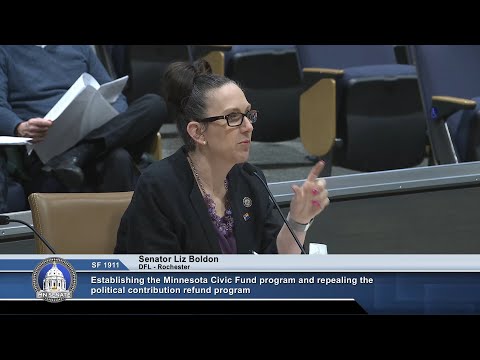
Senate File 19-11, carried by Sen. Karla Bolden, would replace the state's existing political contribution refund (PCR) reimbursement model with a new upfront public-financing system called the Minnesota Civic Fund, the Senate Elections Committee heard March 11.
The measure would issue a unique identifier to verified voters; voters would be able to assign credits in $25 increments, up to $100, to candidates or a party in their district, and candidates could redeem assigned credits for public funds. "We would be replacing the current PCR program with a new public financing program, the Minnesota Civic Fund," Sen. Karla Bolden told the committee. "The bill moves our public campaign financing from a reimbursement model to an upfront model...making our public financing more accessible to more people and empowering everyday Minnesotans in our elections."
Supporters said the change aims to broaden participation in campaign giving and reduce the relative influence of high-dollar outside spending. King County Councilmember Theresa Mosqueda, testifying by video about Seattle's democracy-voucher program, said vouchers helped new donors participate and helped candidates focus on door-to-door outreach. "Democracy vouchers also encourage candidates to get out of dark windowless rooms, dialing for dollars...and instead be on the doors and learn from residents what matters to them," Mosqueda said. Other supporters, including local residents and organizers, said the current PCR process is administratively burdensome for small donors and that an upfront credit would be simpler to use.
Committee members asked detailed implementation questions. Senators asked how the program would be tied to the Secretary of State voter rolls, how the credits could be assigned and redeemed, and how the bill would limit or phase the total redemption value available in a year. Sen. Bolden described one financing limit in the bill: the annual redemption value is capped at 8% of the total dollar value of credits issued for a year, with language to increase the cap by 2 percentage points if it is reached. She also said credits must be redeemed to a candidate or party that represents the voter's district.
Committee members raised concerns about solicitation and transfer of credits. Sen. Bolden pointed to statutory prohibitions in the draft that would bar sale or assignment of credits by proxy or agent and that would forbid purchasing or selling credits. Committee members also sought data on current PCR participation; Sen. Bolden said participation has declined over time and that Seattle's voucher program has seen increased participation.
Supporters cited national spending trends and Minnesota figures during testimony. Sen. Bolden cited national analysis that showed big increases in outside spending after Citizens United and told the committee that, in the 2024 Minnesota state-house cycle, outside spending in top races was almost double candidate spending and that total outside spending in the 2024 state cycle reached about $16,000,000. She also referenced a 2023 survey she said found that 78 percent of likely 2024 Minnesota voters were concerned about wealthy donors' influence.
No final vote was taken on the bill; the committee adopted an author's amendment (A1) earlier in the hearing and then laid the bill over for further work. Sen. Bolden said she would continue to refine the language and take additional input. "This issue is not going away," she said. "Minnesotans are continuing to feel their voices are being drowned out by...big spending."
The committee meeting record shows the bill was laid over; committee staff indicated the measure will be considered again as language is revised and additional stakeholder input is received.