Get Full Government Meeting Transcripts, Videos, & Alerts Forever!
Get email alerts on the Charitable Gambling Tax topic
No spam. Unsubscribe anytime.
Minn. House panel advances bill to cut charitable-gambling tax to 5% amid debate over revenue impact
Summary
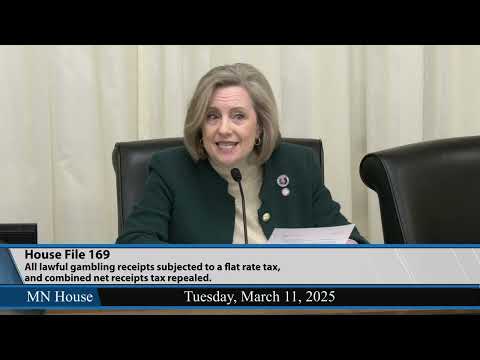
Representative Robbins on the House Tax Committee moved House File 169 and a technical amendment to the bill during a committee hearing, and the committee approved the amendment by voice vote before hearing more than a dozen witnesses.
Representative Robbins on the House Tax Committee moved House File 169 and a technical amendment to the bill during a committee hearing, and the committee approved the amendment by voice vote before hearing more than a dozen witnesses.
The bill would replace Minnesota's tiered charitable-gambling tax on combined net receipts'which currently rises from 8% to 33.5% at the highest tier'with a flat 5% tax, Representative Robbins said. "We are making money for the state on the backs of our charities and this has been going on for a really long time, members," Robbins said, arguing the change would leave more funds in local communities.
Supporters from charities, veterans groups and local clubs told the committee the change is needed after 2023 legislation altered electronic pull-tab game features, which they said has reduced revenue at some sites. Rachel Jenner, executive director of Allied Charities of Minnesota, said charities statewide currently pay about $195,000,000 in taxes annually and that some organizations have reported year-over-year drops of 20% to 40% in their receipts. "In the first month under these new rules, we have heard from charities that are seeing an average 20% drop in their revenue, some as much as 40%, year over year," Jenner said.
Veterans and local nonprofit leaders described programs paid for with gambling proceeds: emergency rent assistance, honor guards, equipment for volunteer fire departments, scholarships and youth sports. Dr. Kristi Janigo, Legislative Chair for the American Legion Department of Minnesota and an assistant county veterans service officer, told the committee her organization uses charitable funds for urgent veteran services and described local examples of rapid help charities provide. "These funds are a big part of how we reached an effective end to veteran homelessness last fall in Hennepin County," Janigo said.
Gambling managers and business representatives urged the committee to consider how Minnesota's tax rates compare with other states. Tim Engstrom, gambling manager for American Legion Post 550, summarized his research on other states' approaches and said, "Minnesota taxes charitable gambling starting at 8.5% ... and it soon climbs up to its top rate of 33.5% of cumulative net receipts." He and other witnesses said Minnesota's tax load on charitable gambling is among the nation's highest.
Committee members pressed witnesses on the size and sources of revenue changes since the 2023 changes to electronic games. Chair Gomez (committee title in hearing) noted state data showing a smaller initial industrywide decline, saying the Gambling Control Board's preliminary January numbers showed roughly a 9% to 13% decline for the first month under the new rules. Jenner and other witnesses responded that individual charities report a wide range of outcomes and that larger or longer-term data are needed to understand lasting effects.
The committee also heard that charitable organizations use portions of gambling proceeds for permitted administrative costs and capital needs. Tim Engstrom described the state's star-rating system for charitable gambling operators, which indicates the share of proceeds directed to mission-related donations versus administrative costs. Witnesses said some organizations use funds for building upkeep, staff, and other lawful operational expenses as allowed by statute and board rules.
Representative Robbins closed by reiterating that the bill is not a repeal of all taxes but a flat-rate reduction that she said would free more local dollars for community uses. The committee laid the bill out for possible inclusion in the omnibus tax bill, the sponsor said.
Votes and formal actions recorded in the hearing included a voice adoption of the A1 technical amendment to H.F. 169, and the sponsor's motion to lay the bill out for possible omnibus inclusion was renewed at the hearing'both recorded as committee actions with voice votes or motions but without a roll-call tally in the transcript.