Get Full Government Meeting Transcripts, Videos, & Alerts Forever!
Get email alerts on the Natural Gas Utility Regulation topic
No spam. Unsubscribe anytime.
Committee advances bill to tie small gas-utility exemptions to systems, not owners
Summary
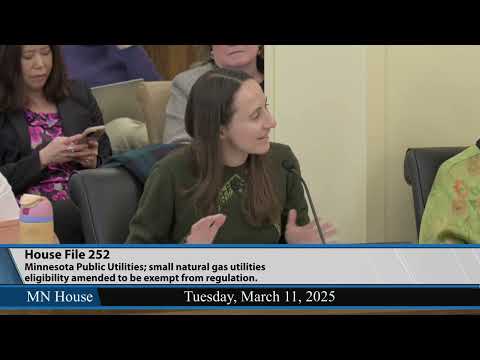
The House Energy Committee voted to place House File 252 on the General Register after testimony that the bill would change the exemption from Public Utilities Commission oversight from a utility-based to a system-based test to preserve local regulation of small gas systems in Greater Minnesota.
Representative Igoe moved that House File 252 be placed on the General Register, and the committee approved the motion by voice vote after roughly 21 minutes of testimony and questions.
The bill would revise exemption language in Minnesota statute so that an exemption from Public Utilities Commission (PUC) rate oversight follows a particular gas system rather than the utility company that owns or operates it. Representative Igoe said the change would support "affordability and reliability for energy" in Greater Minnesota and allow smaller systems to operate under local regulation until they grow large enough to bear PUC rate-case costs.
Rachel Sorrentino, a representative of Northwest Gas, testified in favor of the bill. "We are not looking to be unregulated. We are seeking to preserve existing local regulations, the regulation of small systems that can't bear the costs associated with PUC rate regulation," Sorrentino said. She said the bill would "link an exemption to a system rather than to a utility" so a system could remain exempt until it grows large enough to enter PUC oversight.
Testimony and committee questions addressed several recurring concerns. Representative Carroll asked whether the bill defined "customer" and how that term would be applied. Sorrentino said the PUC has previously defined "customer" as the entity that contracts for service (for example, separate meters under separate accounts count as separate customers). Representative Acum asked whether the bill's definition of "system" appears elsewhere in statute; the testifier said it did not. Representatives also pressed on how many utilities would be affected; Sorrentino said she did not have an exact count but estimated there are "7 or 8 other companies" operating as small gas utilities, and that the bill would immediately help her company and likely others as they grow.
Members raised questions about potential avoidance of regulation through corporate structuring. Representative Kraft asked what would prevent a utility with 10,000 customers from setting up multiple subsidiaries to stay below the PUC threshold; Sorrentino and a committee witness said the PUC already examines common ownership and resources and may treat separate subsidiaries as a single utility if appropriate. Representative Jones and others asked whether customers of small systems would continue to have access to energy-efficiency programming under Minnesota's conservation requirements; a witness called to testify, Bob Eloff, said it was unclear whether the smallest companies are currently subject to ECO programs and recommended follow-up if the bill moves forward.
Representative Igoe framed the measure as a way to allow Greater Minnesota communities and small systems to partner for local infrastructure build-out without immediate PUC rate-case burdens. The committee approved the motion to place the bill on the General Register by voice vote; the motion "prevails," according to the clerk, and no roll call was recorded.
The committee indicated the bill will continue through the legislative process with further consideration of definitional issues and potential follow-up on how energy-efficiency program access would be preserved for customers of exempt systems.