Get Full Government Meeting Transcripts, Videos, & Alerts Forever!
Get email alerts on the Wastewater Infrastructure topic
No spam. Unsubscribe anytime.
Winona seeks $12 million in state bonding to meet MPCA nutrient rules
Summary
City of Winona told the House Capital Investment Committee it needs about $36 million to replace aging wastewater treatment technology and is requesting $12 million in state bonding to meet impending MPCA nutrient removal requirements while limiting large rate increases for residents.
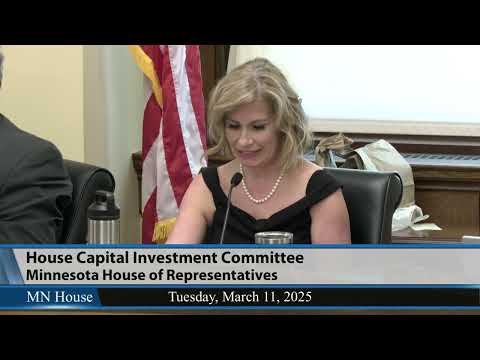
The City of Winona asked the Minnesota House Capital Investment Committee on March 11 for $12,000,000 from the state bonding bill to help pay for a roughly $36,000,000 wastewater treatment upgrade.
The project would replace the plant's original treatment technology to meet "MPCA mandated nutrient removal requirements," city engineer Brian Dufresne told the committee. Dufresne said the city must complete the work by 2028 and that design- and construction-cost inflation has driven the estimate up from roughly $14,000,000 to about $36,000,000.
Why it matters: Winona officials said local affordability is at stake. "Our city has approximately 20% of the population at or below the poverty level," City Manager Chad O'Bull told the committee, and Dufresne said the city has been raising sewer rates to meet costs. "By the time we're done raising rates, they will have increased 700% from where we started," he said, adding that the city could move into the top 15% of sewer rates in Minnesota without state assistance.
The testimony noted other funding attempts and recent local investments: Winona applied to the PFA and was not awarded last year because the statewide bonding bill did not pass; the city is pursuing a potential federal grant of about $1,500,000 that has not yet been awarded. Officials also said the city recently completed a roughly $3,000,000 treatment-plant upgrade and spent about $5,000,000 replacing and upgrading lift stations.
City officials urged the committee to consider either funding assistance or extending MPCA compliance deadlines so local governments can pursue other funding and avoid sharp rate increases. "What will make housing unaffordable is limited or no funding for state mandates," O'Bull said.
Ending: Committee members asked clarifying questions about the requested amount and phasing; Rep. Reyer asked for confirmation that the state ask was $12,000,000, and Rep. Rypinski noted the bill text showed $8.5 million. Winona indicated the project is difficult to phase because the work involves constructing a building that houses the new treatment process.