Get Full Government Meeting Transcripts, Videos, & Alerts Forever!
Get email alerts on the School Trust Lands Boundary Waters topic
No spam. Unsubscribe anytime.
Minn. representative seeks trading, not sale, of school trust lands in Boundary Waters; committee lays bill over
Summary
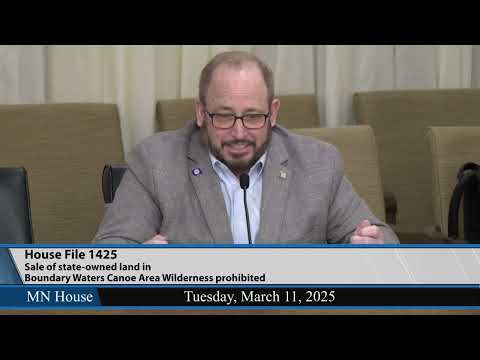
Representative Scraba presented House File 1425, saying the bill would bar the sale of state-owned school trust lands inside the Boundary Waters Canoe Area Wilderness and instead require land exchanges under federal law.
Representative Scraba presented House File 1425, saying the bill would bar the sale of state-owned school trust lands inside the Boundary Waters Canoe Area Wilderness and instead require land exchanges under federal law.
The bill’s author, Representative Scraba, said the intent “is to stop the sale of the land inside the Boundary Waters” and to pursue trades under the federal Wilderness Act of 1964 rather than take a cash sale. He told the committee that revenue from mineral production near Virginia, Minnesota, supports local schools and that he could not support what he described as a low offer for the lands in question.
The committee heard testimony from the Office of School Trust Lands and the Department of Natural Resources, which urged caution or opposition to the bill. Aaron Vandelein, School Trust Lands Director, told members the office opposes HF 1425 and reminded the committee that the trust exists to secure “the long term maximum return” for Minnesota schoolchildren. Vandelein said sales of these particular lands would provide a one-time sale proceeds payment that, if invested by the State Board of Investment, would produce sustained returns for the permanent school fund. “Selling school trust lands is the last opportunity that we can make off of school trust lands to fund education,” he said, and added that lands in the Boundary Waters “have earned $0 for education” while held in federal wilderness since the 1960s.
Bob Myers, commissioner of the Minnesota Department of Natural Resources, told the committee he agreed with Vandelein’s overview and noted that mineral interests were not on the table in prior discussions with the federal government. Aaron Lehi of the Minnesota Center for Environmental Advocacy and Amanda Hefner of Save the Boundary Waters both urged the committee to oppose HF 1425. Lehi said experience shows that managing these acres for resource extraction produces low returns to the trust and that sale proceeds reinvested by the State Board of Investment would generate larger long-term benefits. Hefner said a sale to the U.S. Forest Service would consolidate ownership in the Boundary Waters and deposit proceeds into the permanent school fund.
Members questioned appraisal methods, the federal NEPA process, treaty concerns raised during earlier federal review, and how appraisals account for wilderness restrictions on use. Joe Henderson, Division Director for Lands and Minerals at DNR, said the 2020 appraisal that produced the frequently cited $30,000,000 figure is now dated and that a new appraisal has been completed but the data are not yet public. Committee members also discussed a reported federal appropriation of roughly $50 million for acquiring the lands; Representative Lee Fisher said that federal funds were available and urged the committee to move the sale forward, while Representative Scraba and others said the state should seek trades that preserve state access to timber and mineral revenues.
Representative Fisher offered a DE1 amendment that would have encouraged the sale but withdrew it and instead moved to re-refer HF 1425 to the Education Finance Committee; that motion failed on a voice vote. The committee ultimately laid the bill over for possible inclusion. The chair closed the item by laying HF 1425 over.
Why it matters: The 80,000 or so acres of school trust lands within and adjacent to the Boundary Waters are held to benefit Minnesota’s permanent school fund. Proponents of a sale say proceeds invested by the State Board of Investment would produce sustained funding for schools; opponents say that sales would surrender federal consolidation that benefits land management and tribal treaty rights or would foreclose local management options. The bill and the technical appraisal questions raised in testimony could determine whether the lands are sold, traded, or remain in their current ownership status.
Votes and formal actions: The committee did not advance HF 1425 to another committee; a motion to refer it to the Education Finance Committee failed, an offered amendment (DE1) was withdrawn, and the measure was laid over for possible inclusion in future legislation.