Get email alerts on the Compensatory Revenue topic
No spam. Unsubscribe anytime.
Compensatory revenue review: direct‑certification changes, concentration rules and measurement challenges
Summary
House fiscal staff and committee members discussed how compensatory revenue is calculated, the recent inclusion of medical‑assistance direct certification in counts, the site‑based concentration formula and the difficulty of tracking program effects.
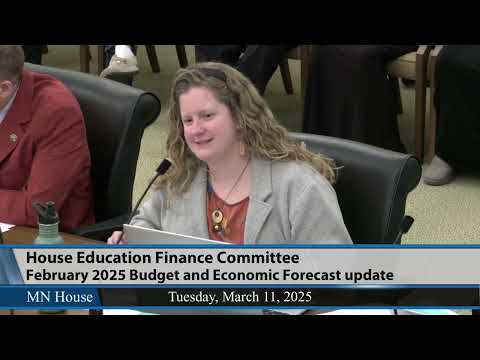
On March 11, 2025, the House Education Finance Committee considered compensatory revenue, the state formula that provides additional general education funding to sites that serve higher concentrations of students eligible for free or reduced-price school meals. House fiscal staff said compensatory revenue is the second‑largest component of the general education formula after the basic formula allowance.
Staff reviewed the measure Minnesota has used since 1996: a proxy based on the federal free and reduced‑price meal (FRPM) eligibility count. Staff explained that eligibility has two federal categories: free meals (household income at or below 130% of the federal poverty level) and reduced‑price meals (income between 130% and 185% of the federal poverty level). The committee was shown a chart of historic FRPM counts: the FRPM share rose through the early 2010s, drifted down in mid‑decade and fell sharply in 2021 (when COVID‑era enrollment and federal universal meals affected reporting). The count rose in 2022 after the Department of Education included medical‑assistance (MA) eligibility matches in the direct‑certification count.
House fiscal staff explained that for fiscal 2026 and forward the department will use the direct‑certification (DC) count only (the paper application totals are no longer used statewide), which reduces comparability with earlier years. Staff warned that the data series is not strictly comparable across the 2010s and post‑2022 counts because the 2022 inclusion of MA direct matches materially increased identified eligible students. Staff said the DC count for 2024 is the input the department will use for compensatory revenue calculations in the next biennium, and that the DC count is substantially lower than combined DC+application counts used prior to the change.
The committee discussed how compensatory revenue is distributed. Staff said compensatory revenue is a site‑based, concentration formula: every site receives some funding, but sites with higher concentrations of eligible students receive additional per‑student funding; the “concentration” design means the marginal compensatory student in a high‑concentration site generates more revenue than the marginal student in a low‑concentration site. Staff also noted statutory requirements that a large share of compensatory revenue remain at the school site (the packet cited an 80% site‑stay requirement in current law).
Staff pointed committee members to the Office of the Legislative Auditor’s 2020 review for deeper analysis and to Minnesota Statutes §126C.15 for the statutory list of 11 allowable uses of compensatory revenue; staff said those uses are broadly written to support strategies primarily meant to improve academic performance. The legislative auditor’s report, staff said, found that isolating compensatory revenue’s separate effect on outcomes is difficult because the funding is deeply interwoven with other district resources.
Members discussed policy options that have been proposed in prior years, including measures to adjust the proxy for poverty, to alter the site‑stay requirement, or to change concentration bands. Several members emphasized the difficulty of making year‑to‑year comparisons after the 2022 change and asked staff for additional district‑level detail so the committee can assess winners and losers under different calculation approaches.
Staff said compensatory revenue will be a policy focus for the committee given its size in the formula and the data‑driven changes to the DC counts introduced in recent years. The committee did not take formal action on compensatory policy during the meeting.
AI generated
The text on this page is AI generated. Summaries, highlights, analysis, and video transcripts are all produced from the original source material.
AI can make mistakes, so if you spot one, and we will fix it for everyone.
Note: the source content is unaltered by us. Any content source we link to, be it a video, an audio recording, or a document, is presented exactly as its publisher released it. That publisher is usually a government body, sometimes an individual official or another organisation.