Get Full Government Meeting Transcripts, Videos, & Alerts Forever!
Get email alerts on the School Trust Lands Boundary Waters topic
No spam. Unsubscribe anytime.
Minn. bill would bar sale of school trust land in Boundary Waters, push for land-for-land trades
Summary
Representative introduced HF 1425 to prohibit sale of state-owned school trust lands inside the Boundary Waters and require trades consistent with cited federal law. State trust and conservation witnesses urged selling to the U.S. Forest Service to generate education revenue; the committee laid the bill over for possible inclusion.
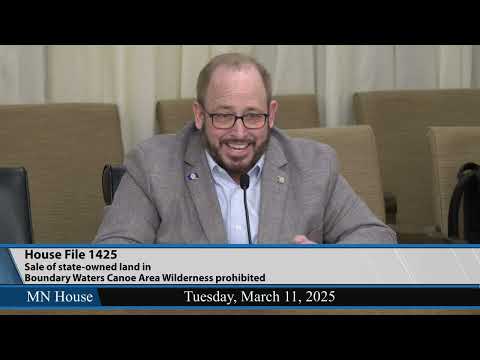
Representative Scraba introduced House File 14‑25 on behalf of constituents in northern Minnesota, saying the bill would prohibit the sale of state-owned school trust land inside the Boundary Waters and require the state to pursue land-for-land exchanges consistent with the federal law he cited.
"So basically what public law 80 eight-five 77 states is it has to be a trade, not a sale, a trade," Representative Scraba said, reading language he said came from a federal wilderness act. He described school trust revenues from mining near Minntac and said a small trade could preserve those revenues for local communities.
Aaron Vandelein, director of the Office of School Trust Lands, testified in opposition. He said the office’s fiduciary duty under state law and the Minnesota Constitution is to secure the maximum long-term return for the permanent school fund and that a sale of the Boundary Waters parcels would generate proceeds the fund could invest for beneficiaries. "Selling school trust lands is the last opportunity that we can make off of school trust lands to fund education," Vandelein said, adding a $30 million hypothetical sale invested by the State Board of Investment could grow substantially over decades.
Bob Meyer, assistant commissioner at the Department of Natural Resources, told the committee the DNR supported Vandelein’s testimony and noted mineral rights would not be negotiable in the way the bill’s author described.
Environmental witnesses opposed HF 14‑25. Aaron Lehi of the Minnesota Center for Environmental Advocacy and Amanda Hefner of Save the Boundary Waters each urged the committee to reject legislation that would bar sale to the U.S. Forest Service, arguing proceeds from a sale should be deposited into the permanent school fund to benefit K–12 education. Lehi said managing the school trust to maximize long-term returns is the statutory goal. Hefner said a sale to the Forest Service would consolidate federal ownership of the Boundary Waters and produce greater long-term returns for schools.
Committee members pressed DNR and school trust staff about appraisals and valuation methodology. Joe Henderson, DNR lands and minerals division director, said the appraisal used to generate the $375‑per‑acre figure dated to 2020 and that the DNR has ordered an updated appraisal. Vandelein said multiple appraisals have been performed over years and that the 2020 number was presented only as a hypothetical.
Representative Lee Fisher offered and then withdrew an amendment that would encourage sale; instead he moved to refer the bill to the Education Finance committee. That motion failed on a voice vote. After additional discussion the committee chair moved that HF 14‑25 be laid over for possible inclusion; members approved the layover by voice vote and the bill was laid over.
Votes at a glance: the committee rejected a motion to refer HF 14‑25 to the Education Finance Committee (voice vote; outcome: failed). The committee approved a motion to lay HF 14‑25 over for possible inclusion (voice vote; outcome: laid over).
The discussion included multiple references to federal withdrawal and prior land-exchange negotiations, differing appraisals, and competing fiduciary duties to school beneficiaries versus local economic interests. Several lawmakers said they supported further discussion; the bill will be considered later as part of omnibus drafting.