Get Full Government Meeting Transcripts, Videos, & Alerts Forever!
Get email alerts on the School Property Tax Levies topic
No spam. Unsubscribe anytime.
Committee reviews school property tax levies: operating referendums, equalization, bond credits and OPEB
Summary
House fiscal staff detailed the February property tax levy tracking for school districts — covering operating referendums, equalization aid, capital and debt levies, the school building bond agricultural credit and OPEB bonds and levies — and explained how local votes and tax base affect district levies.
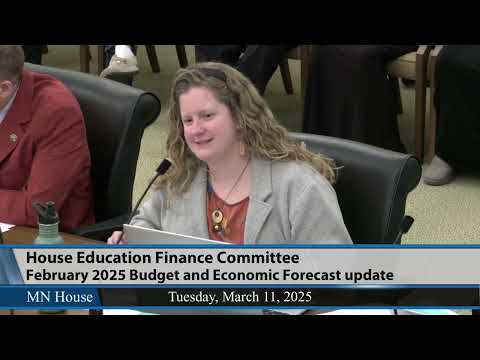
On March 11, 2025, the House Education Finance Committee reviewed a property tax levy tracking spreadsheet prepared by House fiscal staff that updated November 2024 levy estimates to February 2025. Staff said the packet shows general fund levies, community service fund levies, debt service levies, OPEB/pension debt levies and the credits that reduce school property tax levies.
Staff reported that the total certified levies for school districts for the year paid in 2024 (pay 25) were about $3,867,000,000 statewide, according to the spreadsheet. The packet includes line items for commonly used levies: operating referendums, long‑term facilities maintenance (LTFM) levies, capital/technology levies and debt service levies that repay voter‑approved bonds.
House fiscal staff explained how referendum financing and equalization work. The operating referendum is the largest single component of many districts’ levies; voters can approve an operating referendum to raise an additional per‑pupil amount, subject to statutory caps. For lower property‑wealth districts the state provides equalization aid designed to reduce the property tax rate necessary to raise a given revenue amount; staff noted equalization makes a large difference in tax rates between high‑ and low‑property‑value districts.
Staff said districts may also use debt levies to repay voter‑approved bonds for building projects and that most districts go to voters for bond approval. The packet documents a growing use of capital/technology levies in some metro districts that have reached referendum caps.
House fiscal staff pointed out credits on the last page of the worksheet, including the school building bond agricultural credit. Staff said that credit, which started about a decade ago, reimburses roughly 70% of the school building bond tax impact on qualifying agricultural property so that farmers pay less of the school bond levy burden directly; the state provides the credit amount instead.
Staff also reviewed OPEB (other post‑employment benefits) levies and a one‑time 2008 bonding window that allowed districts to issue bonds to prefund OPEB liabilities. Staff said those bond repayments are winding down: one line in the packet showed the remaining bonded OPEB obligation falling to a small amount (staff noted about $17,000,000 remaining by pay 29) while other districts that use a pay‑as‑you‑go OPEB levy show increasing annual pay‑as‑you‑go costs.
Committee members asked how districts legally set levies and whether some levies can be extended by board action rather than voter approval. House fiscal staff explained that operating referendum authority can be extended by school‑board action for up to 10 years in many cases, while debt (bond) levies and technology/capital levies require voter reauthorization if the board wishes to continue them beyond their original approval.
House fiscal staff emphasized the district‑by‑district variability: some districts’ levies fall when bonds are paid off; others rise when voters approve new bonds. Staff said the department produces November reports showing referendum election history that the committee can use to track pass/fail rates and amounts.
Committee members raised equity questions about metro districts’ higher tax bases making it easier for some districts to fund larger construction projects and noted the long‑standing metro/Greater Minnesota differences in referendum passage rates. Staff and members also discussed operating sparsity and long‑term facilities maintenance as distinct mechanisms to assist small or geographically isolated districts.
The levy discussion will inform the committee’s drafting decisions because the House’s informal levy target instructs education committees to avoid producing bills that increase statewide levies without corresponding tax committee adjustments.
The committee’s property tax levy review was presented by House fiscal staff; no formal action was taken on policy in the meeting.