Get Full Government Meeting Transcripts, Videos, & Alerts Forever!
Get email alerts on the Finance And Allocations topic
No spam. Unsubscribe anytime.
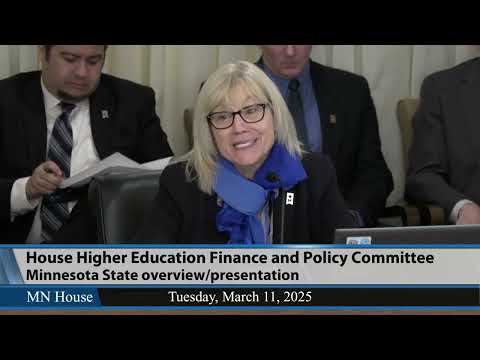
Minnesota State reviews finances: stabilization funding, tuition‑freeze relief, allocation model and other operations riders
Summary
Minnesota State vice chancellors summarized audited financial results, how stabilization and tuition‑relief funds are allocated across campuses, one‑time campus support, technology/ISRS funding, retirement contribution increases (IRAP) and other operations and maintenance riders.
Vice Chancellor Bill Mackey and Director of Financial Planning and Analysis Steve Earnest presented the system’s fiscal picture, describing audited results, allocation formulas and multiple riders that affect campus operating bases.
Bill Mackey, Vice Chancellor for Finance and Facilities, said the system received a clean audit opinion and that its Composite Financial Index improved from 2.3 to 3.6, driven largely by a $167 million increase in state appropriations and an enrollment increase that yielded more tuition revenue. Mackey reported that state appropriations made up about 42% of system revenues in FY24 and tuition and fees about 30% (tuition revenue was roughly $674 million for FY24). He described the system’s allocation model: 55% of the model emphasizes instruction and academic support, 37% student services and institutional support, roughly 7% facilities and small weights for student‑success and research/public service, with 30 institutional allocation lines representing aligned institution groupings.
Mackey summarized several riders and one‑time funds. He said the stabilization funding (allocation model results) produced mixed shifts between institutions depending on enrollment and mission; the biennium included $25 million in tuition freeze relief (allocated based on enrollment to approximate the revenue a 3.5% tuition increase would have generated) and a $50 million one‑time campus support fund distributed by a formula tied to estimated tuition revenue loss since 2019. He said that campuses used the one‑time funds for operational runway, strategic enrollment efforts, facility investments and targeted one‑time program investments.
Steve Earnest reviewed additional operations and maintenance riders. He said $809,000 annually was appropriated for unemployment insurance changes tied to a state law change that expanded summer unemployment eligibility for some nonprofessional employees; initial reporting identified $465,000 of the first year appropriation while additional accounts were still being reconciled. Earnest said IRAP employer contribution increases (from 6% to 8.75%) produced a $14 million increase in employer contributions systemwide; the rider provided $861,000 in FY24 and $872,000 in FY25 and covered only a portion of the total increased employer cost. He also noted a menstrual‑products appropriation ($482,000 in FY24 and $282,000 in FY25) to supply free menstrual products in student restrooms: system surveys counted roughly 3,200 student‑used restrooms and the first year funded hardware plus supplies; FY25 formula allocates by student head count. Earnest concluded with a summary table showing that about $49.5 million of appropriated FY25 funding was one‑time and will not continue into the FY26 base.
Committee members asked about how many contracts Minnesota State negotiates directly versus those negotiated by the governor’s administration and MMB, the timing of bargaining for contracts effective July 1, 2025, and the components of the salary and benefits share of expenses. Mackey explained that Minnesota State negotiates faculty unit contracts (two‑year faculty MSCF, four‑year faculty IFO, MUSAF and administrators plan) while many staff units (AFSCME, MAPE) are negotiated through the state (MMB), and that bargaining timelines vary but negotiations for July 1, 2025 will begin in spring and intensify in summer. Mackey and Earnest offered to provide more detailed position‑level data on compensation shares and regional pay comparisons.
No committee votes were taken during the presentation; presenters provided allocation spreadsheets and asked to continue reporting as budget work proceeds.