Get Full Government Meeting Transcripts, Videos, & Alerts Forever!
Get email alerts on the Education Finance Forecast topic
No spam. Unsubscribe anytime.
February forecast shows short-term K–12 surplus, larger longer-term deficit as inflation raises formula costs
Summary
House Education Finance Committee review of the February 2025 K–12 forecast showed a modest projected balance for fiscal 2026–27 but substantial projected shortfalls for fiscal 2028–29; committee staff said formula inflation assumptions and enrollment-driven entitlements drive most of the change.
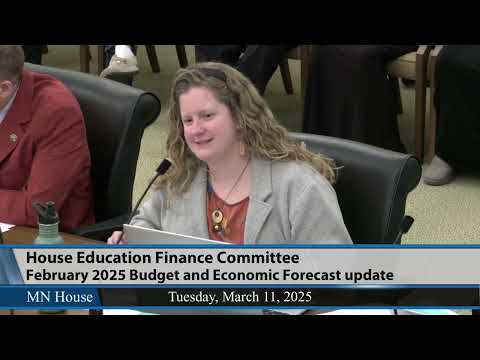
On March 11, 2025, the Minnesota House Education Finance Committee heard a presentation from nonpartisan House fiscal staff on the February 2025 K–12 education finance forecast, which committee staff said members should use as the base for constructing the education finance bill.
The staff presentation said the state’s projected general-fund balance for fiscal 2026–27 is $455,777,000 under the February forecast; staff noted that if inflation is excluded from that calculation the balance would be $1,601,000,000. Staff also showed that for fiscal 2028–29 the forecasted balance is substantially negative: including inflation the February forecast shows a $5,995,000,000 shortfall for FY 2028–29 and without inflation a $2,379,000,000 shortfall, according to the materials presented to the committee.
Committee members were given an eight‑page spreadsheet titled “K through 12 education finance February 2025 forecast aid appropriation summary.” House fiscal staff said the sheet is structured as a base budget: left to right it lists line numbers, program names, prior (November 2024) forecast columns, February 2025 forecast columns, and change columns that highlight activity driven by entitlements such as adjusted pupil units and other enrollment-linked calculations.
Nonpartisan staff emphasized that the biggest drivers of change from the November forecast were inflation assumptions and enrollment/entitlement updates. The general education base (line 8 on the packet) rose modestly in the current biennium but materially in later biennia: staff noted an increase of about $3.4 million for fiscal years 2024–25 compared with November, about $129 million for fiscal 2026–27, and about $245 million for fiscal 2028–29. Staff connected those increases to the change in the CPIU used to compute the formula allowance.
House fiscal staff explained how the general education formula allowance is indexed to inflation under current law: the allowance increases by at least 2% and at most 3% annually, with the inflation factors the commissioner of the Minnesota Department of Education determines. Staff reported the allowance inflation factors used in the February forecast were 2.7% for fiscal 2026 and 3% (capped) for fiscal 2027 and fiscal 2028; the fiscal 2029 factor was below 2% and therefore floored at 2%.
Staff walked the committee through program‑level changes recorded in the forecast. Notable items flagged in the presentation included: small adjustments to nonpublic pupil education and transportation aids based on more recent data; a decline in charter school building lease aid compared with the November forecast; reductions in inter‑district desegregation transportation grants tied to updated fiscal‑year data; and a relatively large reduction in projected take‑up for the paraprofessional paid orientation reimbursement program (the program was created in 2023 and of roughly 500 eligible local education agencies only 208 had sought that reimbursement in the data used). The packet also showed changes to achievement and integration aid, minor enrollment-driven adjustments to American Indian and tribal contract school aid, and a mixed picture for the school meal programs (school breakfast expectations rose while school-lunch costs were shown lower).
The presentation called special education a major cost driver. Staff said special education costs are growing because more students are eligible for services; staff also described the special‑education reimbursement structure in the forecast, noting state reimbursement rates of 44% in the near term and a scheduled rise to 50% in 2027 reflected in the materials.
House fiscal staff flagged that early‑childhood costs have been shifted in some accounts to the new Department of Children, Youth and Families and that some early‑childhood items therefore appear as zeros in the K–12 packet for FY 2024–25 because they are reported in another committee’s materials.
The chair closed the forecast portion by reminding members that the forecast materials are the baseline for bill drafting and that the committee would next review compensatory revenue and the formula overview.
The committee approved the meeting minutes at the start of the session by a voice vote following a motion from Representative Baker; no roll-call vote was recorded.
Next steps: staff said members should use the February forecast spreadsheet as the base for the education finance bill and that committee work will continue on compensatory revenue and the general‑education formula in coming meetings. The committee’s next scheduled meeting is March 13, 2025.