Get Full Government Meeting Transcripts, Videos, & Alerts Forever!
Get email alerts on the Workforce Development topic
No spam. Unsubscribe anytime.
Minnesota State describes workforce riders: sector programming, scholarships, equipment funds and CDA transfer pathway
Summary
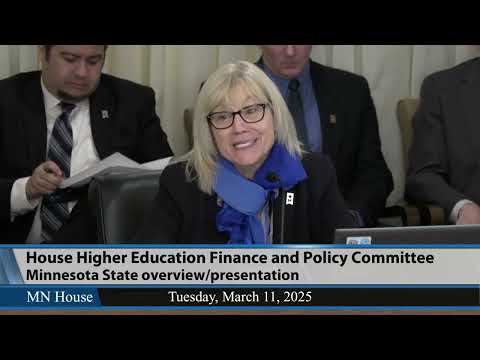
Minnesota State officials told the committee how recent appropriations are funding industry sector programming, workforce scholarships, equipment and learning‑environment upgrades, and a child development associate (CDA) transfer pathway; presenters gave examples and early outcomes.
Minnesota State officials told the higher education committee that workforce‑focused riders are funding industry partnerships, scholarships for high‑demand careers, equipment upgrades and a new pathway for Child Development Associate credential holders to earn college credit.
Jesse Mason, Associate Vice Chancellor for Academic Affairs, described two riders: a $13.5 million one‑time appropriation for equipment and learning environments and a $13.5 million one‑time investment to develop and expand industry‑sector programming. Mason said campuses used 2025 funds through an RFP process that required employer and community match commitments; to date those matches have generated more than $9 million in planned and received investment against $6.75 million of FY25 funding. Mason highlighted dental assisting and dental hygiene expansions at four colleges (Rochester Community and Technical College, Central Lakes College, Century College and St. Cloud-area Ramsey/ Cambridge campus) that leveraged employer donations and Delta Dental support to buy high‑cost equipment (dental chairs cited at more than $45,000 each). He also described a Metro State apprenticeship‑style program that blends work‑based learning across five program areas with employer partners such as KPMG and Securian.
Phil Arellano, Associate Director for Workforce and Economic Development, reviewed the Workforce Development Scholarship program (rider on line 136 of the packet). Arellano said the program awarded more than 2,000 scholarships in FY24, most (about 1,960) to two‑year college students. He said the standard scholarship amount is $2,500 per year and that students may receive awards for up to two years at community colleges and one additional year at a university to promote transfer. Arellano said 42% of scholarships went to students entering health‑care programs; 13% went to transportation fields and 12% to advanced manufacturing. He reported that from FY22–FY23, more than 1,800 scholarship recipients completed credentials and that 80% of graduates were employed within 12 months.
Mason also described a one‑time $6,000,000+ equipment and learning‑environment allocation used for simulation labs, echocardiography machines and trades equipment; campuses paired that funding with matching investments to modernize hands‑on training. He said the Transfer Pathway CDA work team has identified two courses (6 credits) that will be offered to CDA holders for college credit (child safety/health/nutrition and child growth and development) and that further work will establish marketing and pathway enrollment processes.
Committee members asked for average scholarship amounts (Arellano confirmed $2,500 per year) and for further details on employer matches and program scale. Presenters said campuses and industry partners are providing matching funds and cited early examples of program expansions and apprenticeships.