Get Full Government Meeting Transcripts, Videos, & Alerts Forever!
Get email alerts on the Historic Preservation Signs topic
No spam. Unsubscribe anytime.
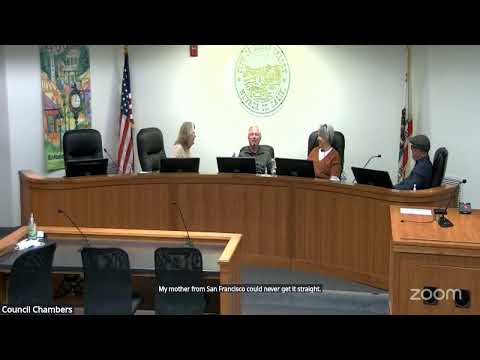
Grass Valley commission backs Texas Tommy's sign exception, asks for straighter lettering
Summary
The Grass Valley Historical Commission on March 11 recommended that the Development Review Committee approve a sign-exception permit for Texas Tommy’s at 122 East Main Street, but asked the applicant to make the lettering straighter and more rectilinear and to keep it within a gold border.
The Grass Valley Historical Commission on March 11 recommended that the city’s Development Review Committee approve a sign-exception permit for Texas Tommy’s at 122 East Main Street, with a modification that the lettering be more linear and remain inside the proposed gold border.
Lucy Rollins, senior planner, told the commission the request covers two signs: a large building-top sign on the East Main Street façade reading “Texas Tommy’s” and a smaller address plate sign on the Richardson Street stairway serving Unit 4. Rollins said both signs exceed the local code’s height limit — which the staff described as placement no higher than the second‑story windowsill or 20 feet — and therefore need a sign-exception permit. She also told the commission staff has determined the project is categorically exempt under CEQA Section 15301, Class 1, as noted in the staff report.
Commissioners discussed design alternatives supplied by the applicant. Amanda, the sign designer representing Miss Moth (the applicant), said she set the main sign’s text at an angle to increase letter height for readability for viewers on the street. “The reason why I chose to set the text at an angle was just to give a little more space for the lettering height, due to, like, the distance for the person that would be on the ground looking up at it,” she said.
Several commissioners said they supported honoring the building’s history but preferred a more rectilinear treatment. Commissioner Mark said the proposed lettering “seems a little more fitting of a business sign versus a building sign” and recommended a more blocky, rectilinear design that fits the parapet. Commissioner Teresa said she preferred option 4 from the applicant’s packet and asked that “Texas” appear on a straight baseline rather than slanted. Commissioner Diane likewise supported moving toward a squared-off design for the main sign while noting the smaller rear address sign was acceptable.
Commission chair Miranda read a revised recommendation that the Historical Commission ask the Development Review Committee to approve the development-review permit and the sign-exception permit, with the modification that the Texas Tommy’s text be more linear or rectilinear and remain within the gold border. Commissioner Mark moved approval of the revised recommendation; Commissioner Diane seconded. The roll call was recorded as four ayes and the motion passed.
The commission’s recommendation asks DRC to: (1) determine the project categorically exempt under CEQA Section 15301 (Class 1); (2) adopt findings of fact for the development-review permit as presented in the staff report; and (3) approve the sign-exception permit in accordance with the staff report’s conditions, with the design modification noted above.
Background: the building at 122 East Main Street dates to about 1860 and is a “priority 2” structure contributing to the Grass Valley historic district. Its long commercial history includes use as the Golden Gate Saloon and later Frank’s Pizza; the space recently reopened as Bicycle Thief Pizza with residential units above. The applicant provided four sign design alternatives and indicated a preference for option 1 but offered the other options if DRC or the Historical Commission requested changes.
Next steps: the Historical Commission’s recommendation will go to the Development Review Committee and then to the Planning Commission as required by the city’s review sequence for sign exceptions in the historic district.