Get Full Government Meeting Transcripts, Videos, & Alerts Forever!
Get email alerts on the Jail Capacity And Site Selection topic
No spam. Unsubscribe anytime.
Consultants outline 468‑bed jail program, site options; board to review draft report
Summary
Consultants presented a jail system assessment and a 4‑phase program calling for a 468‑bed facility with specialized mental‑health housing, multiple site options and strategies (pretrial screening, electronic monitoring, diversion) that could reduce bed needs. No site or funding decision was made; a draft report is due in April–May.
At a March 11 work session in Bisbee, Cochise County officials heard a planning firm and architects present a system assessment and site options for a proposed new county jail, summarizing a program that would support a 468‑bed facility and related court and sheriff’s spaces while urging steps that could reduce future bed demand.
Karen Chen of Chen Planning, the lead presenter, told the Cochise County Board of Supervisors the study examined arrests, court filings, probation and local treatment capacity “to be able to inform decisions about future need for jail capacity.” The consultant team (DLR Group architects and Chen Planning) provided a program that would include specialized medical and mental‑health housing, an initial‑appearance courtroom and space for sheriff’s operations and courthouse functions.
The presentation emphasized that length of stay — not admissions — is currently the primary driver of population. “Average length of stay has gone up,” Chen said, “and it’s driving the population more than how many you’re admitting.” The consultant showed average daily population (ADP) rising from roughly 273 in 2014 to about 298 in the most recent annualized figures, with a peak ADP in 2022–23 near the low‑to‑mid 300s. Monthly admissions were presented as down about 12 percent over the same period, while average length of stay increased from roughly 16.4 days to about 20 days.
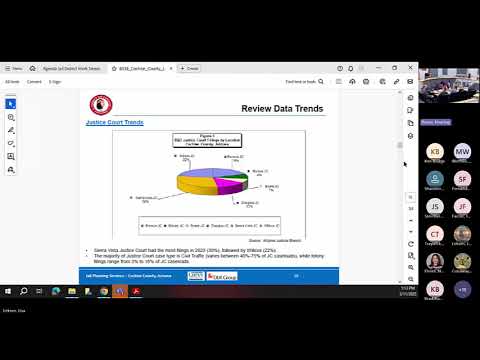
The team estimated that about 82 percent of inmates on a snapshot day were in pretrial status, that about 20 percent of inmates were on psychotropic medication, and that inmates seen by psychiatric providers rose 86 percent over two years. County felony filings were shown as increasing (approximately 6 percent per year for felony filings), even as overall reported crime and arrests declined by about 5 percent annually from 2017–2023.
To accommodate projected needs and classification/peaking factors, the program summary adds a 20 percent planning factor to ADP and results in a design program of 468 beds (with support capacity sized to serve roughly 500 inmates). The jail building program in the consultants’ summary totaled about 205,000 gross square feet; the court program was shown at roughly 141,000 gross square feet and a sheriff’s building at roughly 57,000 gross square feet. The consultants noted phasing and modular design options and said those totals could be refined during design to meet budget constraints.
Commander Bradshaw of the Cochise County Sheriff’s Office clarified a dataset presented by the consultants, saying the slides combined the population of the county’s three detention facilities: “Those numbers … are a compilation of all three jails combined,” Bradshaw said. The consultant team said they used that combined dataset because inmates are moved among the county’s jails.
The consultants recommended several non‑construction approaches that could materially reduce future bed needs: expanded pretrial screening and electronic monitoring, validation of a uniform bond schedule across justice courts, expanded diversion and specialty courts (mental‑health and drug court), and better data systems to speed case processing. The team also recommended specialized housing and staffing for mental‑health and medical needs in any new facility.
Six preliminary sites were shown as part of an early “test fit” and scorecard exercise: Sierra Vista, Douglas, Tombstone, Bisbee (Melody Lane), Benson and multiple schematic options for the existing jail site. The consultants estimated that a full campus (jail, courthouse, sheriff) could require on the order of 40–42 acres for future expansion and parking, depending on configuration. The presentation stressed that site selection would need more detailed cost estimates for utilities, sewer, road improvements and land acquisition before the board chooses a preferred location.
No formal action or vote was taken during the work session. The board asked for the draft report (the consultants said a draft would be issued in April–May) and discussed next steps, including whether to retain an owner’s‑representative/ program manager to oversee design and construction should the board decide to move forward. Supervisors raised operational and equity concerns about locating major county facilities outside population centers and noted transportation, utility and long‑term operational costs as key factors.
The county staff and consultants will return with the written draft program and a site‑scoring packet. The board will decide whether to advance to design and acquisition; no site or budget decision was made at the March 11 session.