Get Full Government Meeting Transcripts, Videos, & Alerts Forever!
Get email alerts on the Climate Action Plan topic
No spam. Unsubscribe anytime.
Pitkin County staff present draft Climate Action Plan; commissioners ask for clearer metrics and timing for targets
Summary
Staff presented a draft countywide Climate Action Plan that organizes 38 specific actions across six focus areas. Commissioners asked for clearer success metrics, funding options and a future work session to consider accelerating long-term emission-reduction goals.
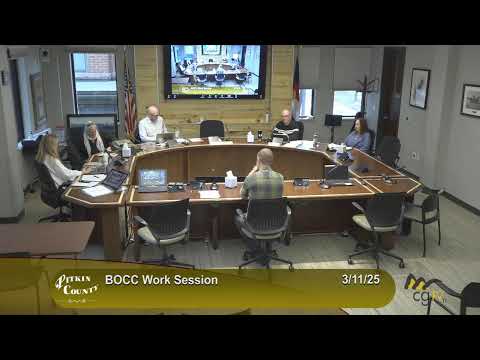
Staff from Pitkin County presented a draft Climate Action Plan on March 11, describing a cross-departmental effort to gather and prioritize ideas for reducing greenhouse gas emissions from county operations and the community.
The plan organizes 38 actions into six emissions-focus areas covering buildings, transportation, waste, natural resource management, internal operations and regional coordination. Presenters said departments participated in sector-focused conversations and that the plan is intended as a “living document” to be updated as new opportunities emerge. Staff emphasized the plan ties previous directions given to county departments into a single, more interwoven implementation framework.
Commissioners asked several questions about how success would be measured and the plan’s assumed targets. Staff said many actions can be linked to measurable GHG reductions at a project level while some items — for example upstream procurement emissions — will be harder to quantify. Commissioners urged the use of interim and project-level metrics so incremental wins can be identified and celebrated.
The presentation also raised the question of whether Pitkin County should update its long-range goals to align with recent scientific guidance. Staff said a third‑party analysis indicates alignment with global targets would imply reducing community emissions by roughly 65% by 2030 and essentially to net zero by midcentury; staff recommended a separate work session to consider adopting an accelerated interim target and to coordinate with Vision 2050 and other county initiatives. Commissioners indicated interest in scheduling a follow-up discussion but did not adopt new targets at the meeting.
The plan calls out several pilot and large projects — including building electrification and a microgrid for county facilities — that staff described as both ambitious and testable ways to measure impact once implemented. Staff also noted the airport is working on its own emissions plan and was intentionally not folded into the county plan at this stage, though staff said airport staff had been consulted during planning.
Next steps identified in the presentation include continued departmental engagement, development of additional project-level metrics, a resilience progress report to map climate adaptation work, and follow‑up coordination with regional entities. Staff said they would bring an informational packet and potential schedule for a dedicated work session if the board wants to consider updating the county’s interim or long‑term goals.
Commissioners expressed support for the approach but repeatedly asked staff to return with clearer metrics, estimated costs and a prioritized list of actions that show relative reduction and cost-effectiveness so elected leaders can weigh tradeoffs. Staff said they will return with additional implementation details and offered to present a fuller briefing at a future board meeting or work session.