Get Full Government Meeting Transcripts, Videos, & Alerts Forever!
Get email alerts on the Public Art Planning topic
No spam. Unsubscribe anytime.
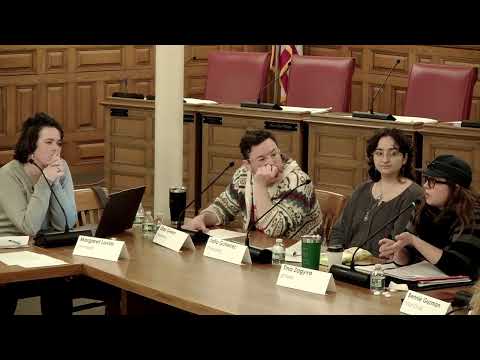
Syracuse Public Arts Commission seeks community input as it refines mission, outreach and funding
Summary
At a packed public forum, the Syracuse Public Arts Commission presented draft mission and vision statements, outlined six task forces and described new funding and procedural limits — including a $35,000 capital line — while artists and residents pushed for clearer processes, insurance support and state-level advocacy for I-81 corridor art.
The Syracuse Public Arts Commission reopened public conversation about how the city should support and show public art, presenting draft mission and vision statements and asking residents to weigh in on priorities including outreach, funding and maintenance.
"The mission of the City of Syracuse Public Arts Commission is to enrich our neighborhoods by promoting the creation and collection of public art that reflects community values, fosters inclusivity, inspires engagement, and highlights Syracuse as a thriving arts destination," Commission Chair Tina Zagiba said at the Oct. 27 forum as commissioners asked attendees to comment on draft language and to complete a follow-up survey via QR code.
Commissioners said the forum was part of a push now that the city has a full-time public art coordinator and a new home inside Parks and Recreation. Anne Cofer, the city's public art coordinator, told attendees the commission is using the moment to simplify its 44-page master plan and make the application process less cumbersome for artists and community groups.
Members outlined six task forces aimed at implementation: website and social media; finance and funding; public art program planning and outreach; business and organizational partnerships; master-plan simplification and applications; and artist education. The commission said it was building a website map of public works and expects a public rollout soon.
Commissioners and staff described the practical limits of the commission's authority. The city budget now includes $35,000 earmarked for public art — described by staff as capital-improvement money that can be used for long-term maintenance — and the commission noted those funds are subject to Parks and Recreation budgeting rules. Donations to the commission itself are restricted: Cofer said SPAC cannot solicit or accept donations directly; donations must be routed through a separate association, fiscal sponsor or a formal acceptance process that runs through the mayor's office and city council and can take about a year.
Several artists and neighborhood representatives urged clearer rules, better support and faster help for artists. Chloe Flores, a Syracuse muralist, said her recent city-commissioned mural received little logistical or community support and no unveiling event. "There was little to no guidance, and the community did not receive an unveiling ceremony," Flores said. She and other speakers urged a standardized onboarding process that covers community engagement, project safety and a grievance channel for artists and workers.
Insurance and maintenance emerged as recurring concerns. Michael Giannattasio asked whether artists are expected to carry long-term insurance and how maintenance and weather damage will be handled. Cofer said that, under current practice, artists installing sculptures on public property are responsible for insurance and that the commission is discussing ways to streamline or identify fiscal solutions but does not currently have a city-wide insurance pool in place.
Speakers also urged improved outreach and promotion. Commissioners described social accounts (Facebook: Syracuse Public Arts Commission; Instagram: SYRPAC) and noted that city-run social media are public records and must be retained for seven years. The commission discussed using modest paid advertising (several speakers proposed small Meta boosts) and free listings such as CNY Arts to increase RFP visibility; commissioners said they hoped to improve how RFPs are distributed and to boost artist registry outreach.
A number of public commenters asked the commission to press for public-art opportunities tied to larger infrastructure work. Emmanuel Carter and other commissioners said they are talking with parks staff and state representatives about the I-81 viaduct project and the Business 81 corridor; they said the state Department of Transportation will control many of those construction decisions and that local advocates will need to press DOT and elected officials to reserve sites or budget lines for art.
The meeting included opportunities for neighborhood groups and business representatives to offer partnership ideas. Joe Violet of the Downtown Committee, Jim Ammons of the Syracuse Poster Project and Sam Gruber of the Westcott Neighborhood Association each said they are willing to help promote projects, identify possible walls and venues, and connect the commission with festivals and other marketing channels.
The commission repeatedly invited attendees to join task forces. "Think of us as connectors," Cofer said. Commissioners urged participants to sign the survey and provide contact details so the commission can coordinate advocacy and follow-up work, including a plan to adopt final mission and vision language in April and to produce a strategic plan informed by this forum.
Votes at a glance: the standing meeting approved the minutes from the previous session and later adjourned by voice vote. The commission recorded the motions but did not record roll-call tallies during the public forum; both motions carried by voice vote.
What comes next: commissioners said they will close the digital survey after a short window of responses, compile highlights and circulate a strategic-plan outline to participants who provide contact information. They also said a city public-art map is nearing launch and that task-force volunteers are being sought to help with outreach, education, funding searches and RFP distribution.
The forum drew many speakers and a higher-than-expected turnout, the commission said; organizers concluded by asking participants to stay connected through the commission website and social channels and to sign up for task-force work and future updates.