Get Full Government Meeting Transcripts, Videos, & Alerts Forever!
Get email alerts on the Policing topic
No spam. Unsubscribe anytime.
Indiana Senate passes bill clarifying 25-foot "reactionary gap" for law enforcement
Summary
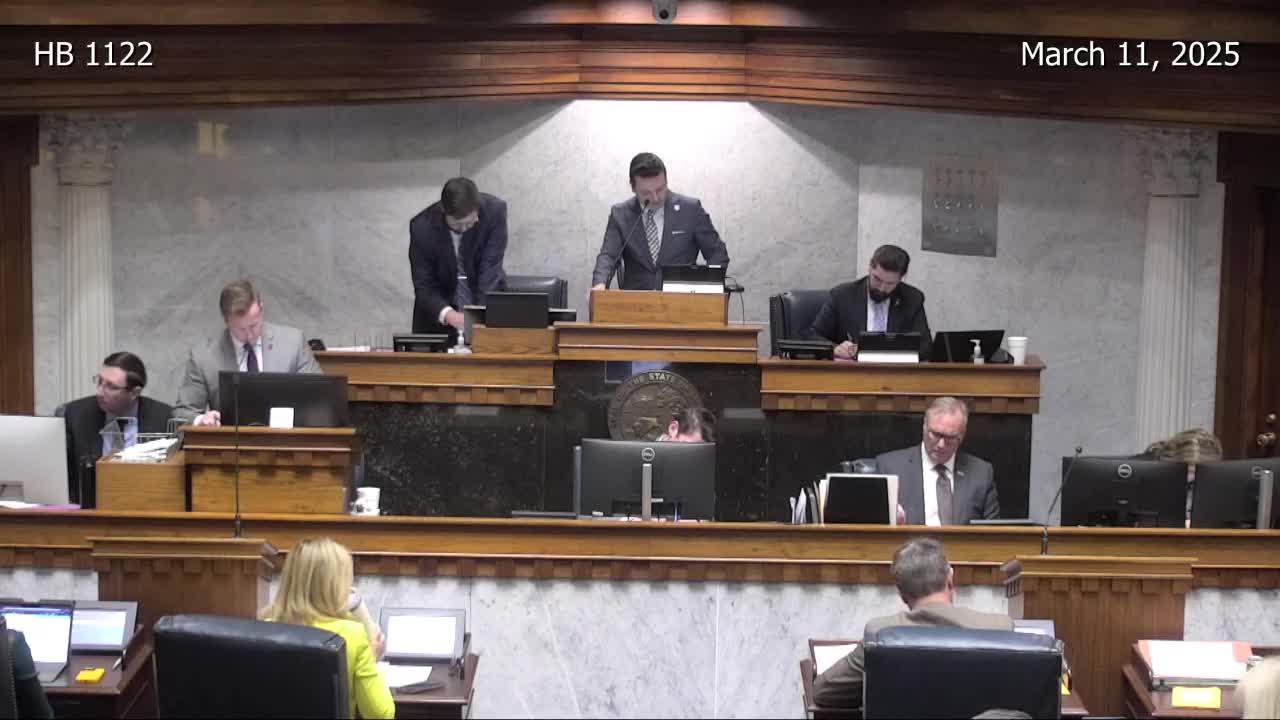
The Indiana Senate approved House Bill 11-22 on third reading after an extended floor debate. The bill preserves a 25-foot reactionary gap but adds a requirement that an officer must reasonably believe a continued approach would interfere with duties before ordering someone to move; vote was 39–10.
INDIANAPOLIS — On March 11, 2025, the Indiana Senate passed House Bill 11-22, a measure that retains a 25-foot “reactionary gap” around law enforcement officers and adds language requiring an officer to reasonably believe that a person’s continued approach would interfere with official duties before ordering them to move. The vote was 39 ayes and 10 noes.
Supporters said the change responds to a court ruling that found earlier language vague; opponents contended the statute still raises enforcement and due-process problems, particularly how distances would be measured and whether officer discretion is too broad.
The bill’s author, Senator Baldwin, told colleagues the change is intended to resolve the vagueness identified in litigation over the earlier 25-foot standard by making interference — and a reasonable belief that interference would occur — an element of the offense. "This bill is about interference," Baldwin said during floor debate, distinguishing interference from officer safety concerns.
Senator Pohl asked a series of technical questions about whether the bill would allow law-abiding bystanders already within 25 feet to be ordered out of that space. "If I'm standing right here and you were being arrested and I wanted to just sit there and make sure everything was done properly, I could not be asked to leave the 25 feet because I . . . am not approaching," Pohl said while questioning the author. Baldwin agreed that the operative term is "approaching," and said presence alone does not automatically trigger the statute.
Senator Young pressed on measurement and proof issues, asking how a defendant could show after an arrest that they were outside the 25-foot boundary if the officer claimed otherwise. Young argued the distance could be impossible to prove in court and said he would vote against the bill because of the burden that could place on defendants. "I don't know how I can prove that I wasn't within the 25-foot range," Young said.
Senator Taylor and others expressed concern about discretion given to officers. Taylor warned the bill could allow an officer to repeatedly order someone farther away — potentially out of their home — if the officer claimed a reasonable belief of interference. "Now all we gotta do is say, ‘I feel like you're messing with my investigation. Get back,’ and if not, you commit a misdemeanor," Taylor said, announcing a no vote.
Senator Rogers spoke in support, saying local law enforcement had urged clarification and that the measure would help officers manage scenes where bystanders create difficulties.
Baldwin closed by reiterating the distinction between safety and interference: "I am not allowed to tell you to go beyond 25 feet if I don't feel unsafe, but I feel you're interfering," he said, and added that officers will still need to articulate their reasons to a jury or judge.
The bill passed on a 39–10 vote and, according to floor remarks, will be sent to the governor. The author and several supporters said body-worn and bystander video will frequently provide evidence to help resolve disputes about proximity and interference in later proceedings.
Clarifying details noted on the floor included the retained 25-foot measurement (described repeatedly as the "reactionary gap") and the added requirement that ordering someone to stop approaching requires a reasonable belief by the officer that further encroachment would interfere with duties. The floor also recorded repeated statements that the earlier statute had been challenged in court (referenced as a district court decision) and that language was intended to conform to guidance from that litigation.
The session record shows extended questioning and back-and-forth on the statute's operation, with several senators saying they supported officers' safety while still worrying about civil liberties and the practicalities of proving distance after an arrest.