Get Full Government Meeting Transcripts, Videos, & Alerts Forever!
Get email alerts on the Internet Voting topic
No spam. Unsubscribe anytime.
Subcommittee advances bill to bar internet return of completed ballots
Summary
The Elections & Campaign Finance Subcommittee voted 6-1 to send HB 139 to the special calendar after adding an amendment that defines internet voting and clarifies the bill’s scope; supporters cited federal agency warnings and opponents raised concerns about impacts on voters with print disabilities and military voters.
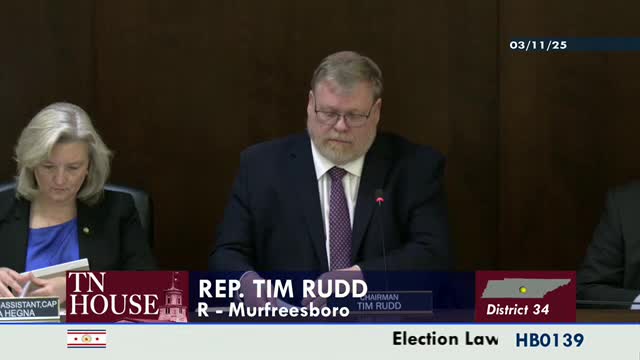
A Tennessee legislative subcommittee on March 11 advanced House Bill 139, a measure that would prohibit returning a completed ballot over the internet, voting 6-1 to place the measure on the special calendar for the final calendar.
Supporters said the amendment to HB 139 clarifies definitions and expressly bars transmitting a voted ballot by internet, citing federal warnings about security risks. Opponents and election officials raised concerns that the bill as written could conflict with state provisions allowing electronic distribution of fillable ballots for certain voters and could expose the state to litigation.
Representative Todd Warner, sponsor of HB 139, told the committee the amendment compiles definitions from multiple sources — including academic and federal guidance — “clearly to define the parameters included in the bill.” Warner said the bill is intended to ensure “no county or government entity enters into any agreement” enabling internet return of cast ballots.
Andrea Gomez, chair of Tennessee Fair Elections, testified in favor of the bill. “This bill is specifically written to prohibit the transmission of a completed ballot via the Internet,” Gomez said, adding that federal agencies including the Department of Homeland Security, CISA, the Election Assistance Commission and the FBI have warned that electronic ballot return presents significant risks. Gomez also said the bill does not change existing provisions that allow distribution of blank, fillable ballots to certain voters, such as UOCAVA (overseas military) voters and those with print disabilities.
Mark Goins, Tennessee coordinator of elections, told the panel the secretary of state’s office is not planning to implement internet voting and would not do so absent legislative direction. But Goins warned that the bill’s current language could conflict with state law authorizing electronic transmission of fillable ballots for voters with print disabilities and UOCAVA voters if the measure is not narrowed. “If you pass this legislation as it’s written, it is contrary to state law, we will get sued and we will lose,” Goins said, citing a Fourth Circuit case discussed in testimony.
Committee members discussed those legal risks and the bill’s exceptions. Warner said the bill’s intent is not to prevent voters with disabilities from voting but rather to prohibit returning a completed ballot by internet, phone or Wi‑Fi.
The committee voted to attach an amendment and then to send HB 139 to the special calendar; the clerk recorded 6 ayes and 1 nay. Committee members said they would attempt to resolve the concerns before further action.
If enacted as drafted, HB 139 would make internet return of a completed ballot a prohibited practice for state or county officials and would bar counties from contracting with third-party vendors to enable that practice. The bill’s amendment and committee discussion preserved explicit exceptions previously provided for UOCAVA voters and for electronic delivery for certain voters with print disabilities, but testimony indicated disagreement over whether the amended text as offered still creates a conflict with existing state law.
Supporters urged the subcommittee to send the bill forward to prevent risks they describe as threats to ballot confidentiality and system availability; election officials urged the committee to refine statutory language to avoid interfering with legally authorized accommodations.
HB 139 was placed on the special calendar for the final calendar, with committee members saying they will attempt to reconcile the disability and military exceptions noted in testimony.