Get Full Government Meeting Transcripts, Videos, & Alerts Forever!
Get email alerts on the Transportation topic
No spam. Unsubscribe anytime.
Tennessee transportation subcommittee advances multiple bills, rolls several for further study
Summary
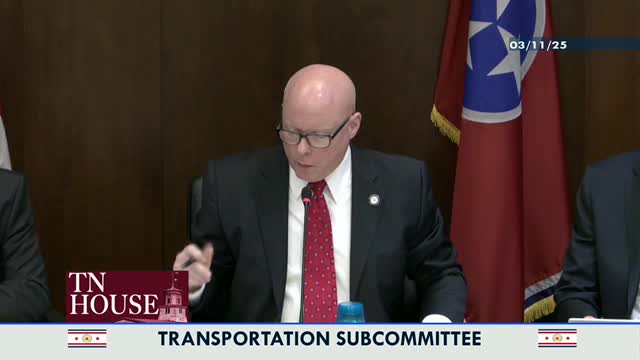
The Tennessee House Transportation Subcommittee on March 11, 2025 advanced a slate of transportation bills to the full committee, approved a limited nonprofit titling carve‑out, and rolled several measures for more study.
The Tennessee House Transportation Subcommittee on March 11, 2025 advanced a slate of transportation-related bills to the full transportation committee, approved a carve-out for a nonprofit that donates repaired vehicles, and rolled several measures for additional work or further study.
The committee’s actions followed brief explanations by sponsors and limited debate on several measures. Several bills passed unanimously; one drew opposition and passed 8–1. Chairman Howe and committee members emphasized the need to move routine items to full committee while reserving time to continue discussion on more complex or fiscally significant measures.
Votes at a glance
- House Bill 127 (advanced to full committee, vote 9–0): As amended in subcommittee, the bill reintroduced a definition of “public transit” that had been omitted and removed rental cars from a proposed special option tax; rental-car transactions were excluded because sponsors said they are already taxed multiple times. The amendment and sponsor’s explanation noted any special option tax authorized by the bill still must be approved by voters in a referendum. (Sponsor: Chairman Howe.)
- House Bill 1129 (advanced to full committee, vote 9–0): The adopted amendment was described as protecting existing borrow pits (quarries) that have FEMA disaster contracts so those operations can continue to supply gravel and other materials for post-disaster rebuilding. Sponsors said the amendment was coordinated with the Tennessee Department of Transportation and leaves federal compliance (for example, Clean Water Act requirements) intact. (Sponsor: Representative Trevor Farmer.)
- House Bill 621 (advanced to full committee, vote 9–0): The bill would ease renewal paperwork for firms that offer motor vehicle warranty-protection products, allowing a warranter to file a straightforward renewal when there are no changes to the product while keeping the 30‑day change-notice requirement. (Sponsor: Representative Eldridge.)
- House Bill 624 (advanced to full committee, vote 9–0): The bill would permit county clerk offices to adjust standard service and shipping charges for mailed license plates and decals; the sponsor described it as a permissive measure to help clerks keep pace with rising postal and handling costs. (Sponsor: Chairman Kiesling.)
- House Bill 859 (advanced to full committee, vote 9–0): An amendment revised the statutory definition of a “fully enclosed” vehicle to accommodate certain veterans who use an auto‑cycle (also called a slingshot) and cannot wear a helmet for medical reasons; the revised definition requires sides, a roll bar or roof and a windshield. Multiple members expressed support on veteran‑service grounds. (Sponsor: Representative Alexander.)
- House Bill 302 (advanced to full committee, vote 8–1): The bill adds criminal penalties for stopping on a public road to solicit employment. A first offense would be a class C misdemeanor; a repeat offense that causes an accident would be a class B misdemeanor. Representative Bain led objections in committee, saying the measure could disproportionately affect day laborers and small businesses that rely on informal hiring. Sponsor Representative Zim Martin said the bill targets activity on public roads and does not prevent hiring on private property or parking lots. (Sponsor: Representative Zim Martin.)
- House Bill 736 (advanced to full committee, vote 9–0): The bill would direct a study of Tennessee’s long‑term transportation funding needs, including potential revenue options such as car‑rental fees, delivery/retail fees, highway impact fees for trucks, and road‑usage fees. The sponsor set a delivery deadline for the study of September 30, 2026. (Sponsor: Representative Bridal.)
- House Bill 737 (advanced to full committee, vote 9–0): The bill creates a formal mutual‑aid mechanism allowing a county clerk’s office to request assistance from a neighboring clerk’s office during temporary closures caused by disasters, public‑health emergencies or other closures; the assisting clerk may charge a $2.50 fee and collect taxes due on behalf of the served county. (Sponsor: Representative Bridal.)
- House Bill 790 (advanced to full committee, vote 9–0): The bill would allow the DMV to accept NGB‑22 forms in addition to DD‑214s so National Guard veterans can receive a veteran designation on driver licenses. Committee members who are veterans voiced support. (Sponsor: Representative Bridal.)
- House Bill 1168 (rolled to the first calendar of 2026): The sponsor asked the committee to roll the bill, which would change aspects of autonomous vehicle law requiring a human driver to be present in vehicles with automated driving systems; the committee agreed to roll the measure for additional study and stakeholder discussion. (Sponsor: Representative Bridal.)
- House Bill 1021 (rolled one week after extended testimony): The bill would treat outdoor advertising structures (billboards) the same as other structures under the Real Property Acquisition Act so owners could seek just compensation when signs are taken or adversely impacted by public projects. Industry witnesses and TDOT testified at length. Jay Klein, director of legislation for the Tennessee Department of Transportation, said the department is “neutral” on the policy but raised a fiscal concern: fiscal review for a similar proposal in 2023 produced a $22,000,000 recurring fiscal note for state and local governments and the department warned that adopting just‑compensation treatment could increase right‑of‑way costs and affect TDOT’s 10‑year plan. The committee voted to roll the bill one week to allow continued discussion. (Sponsor: Representative Russell; witnesses: Lisa Repetoe and Holly Kirby, Outdoor Advertising Association of Tennessee; TDOT: Jay Klein.)
- House Bill 536 (advanced to full committee, vote recorded as 7–0 in subcommittee): The bill (as amended) would create a limited motor‑vehicle dealer license pathway for certain nonprofit organizations that receive donated vehicles, repair them and donate them to people in need (example organization named: Mechanics on a Mission). The amended language requires the nonprofit to be incorporated in Tennessee and to operate a program that receives, repairs and donates vehicles to individuals with demonstrated need; sponsors said the organizations would not sell the vehicles. The sponsor said stakeholders were working with the Department of Commerce and Insurance on final language. (Sponsor: Leader Love.)
Other calendar housekeeping
- At the start of the hearing the committee took a series of preliminary steps: House Bill 1284 (item 6) was rolled one week; House Bill 615 (item 7) was taken off notice; House Bill 556 (item 13) and House Bill 537 (item 14) were rolled one week; omnibus House Bills 212 and 213 (items 17 and 18) were rolled to the final calendar.
What committee members emphasized
Committee members broadly favored advancing routine and technical fixes to full committee while reserving additional time for items with larger fiscal or policy implications. Representative Bridal and others urged continued study and stakeholder negotiation on the billboard/just‑compensation question after industry witnesses and TDOT raised competing concerns. The sponsor of the study bill (HB 736) said the study was intended to identify sustainable, diversified revenue options to address long‑term highway and bridge needs as vehicle fuel use changes and inflation raises construction costs.
Quotes from the hearing
- Jay Klein, director of legislation for TDOT: “From a philosophical position, the department is neutral,” and he warned that the billboard proposal’s fiscal estimate could force TDOT to rework its 10‑year plan because of higher right‑of‑way acquisition costs.
- Lisa Repetoe, Outdoor Advertising Association of Tennessee: committee testimony centered on the inconsistency of case law and current practice in Tennessee that, she said, often limits billboard owners to relocation expenses rather than full just compensation when signs cannot be relocated.
Next steps and outlook
Most measures advanced to the full transportation committee for further consideration. The subcommittee rolled several items to allow sponsors and affected parties more time to refine language and address fiscal or regulatory concerns. The billboard compensation bill drew the most prolonged testimony and a fiscal note concern from TDOT and will be revisited next week; the autonomous‑vehicle measure was rolled to the subcommittee’s first calendar in 2026.
Ending: The subcommittee adjourned after completing the calendar and taking the votes recorded above.