Get Full Government Meeting Transcripts, Videos, & Alerts Forever!
Get email alerts on the School Enrollment Undocumented Students topic
No spam. Unsubscribe anytime.
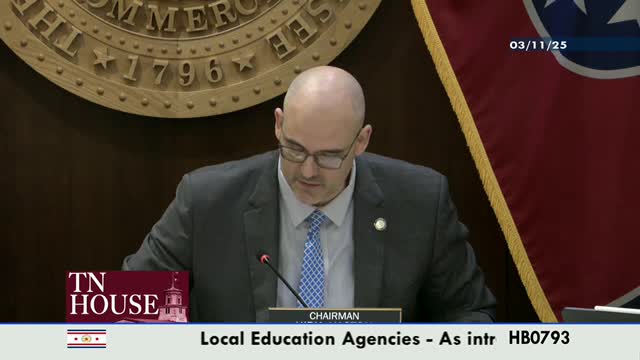
K-12 Subcommittee advances bill letting local districts refuse to enroll students unlawfully present in U.S.
Summary
The K-12 Subcommittee voted 5-3 to advance House Bill 793, a one-sentence proposal that would let a local education agency (LEA) or public charter school "enroll or refuse to enroll a student who is unlawfully present in The United States."
The K-12 Subcommittee voted 5-3 to advance House Bill 793, a one-sentence proposal that would let a local education agency (LEA) or public charter school "enroll or refuse to enroll a student who is unlawfully present in The United States." The committee advanced the measure to the full education committee after roughly one hour of testimony and questioning.
The measure’s sponsor, identified in committee as Leader Lambert, described the bill as a local-control measure, saying it would allow districts to ask for the same documentation they routinely request now — "proof of residency and immunization records" — and, at their discretion, to require proof of legal presence. "It is a 1 sentence bill," Lambert said, adding that the change would be "entirely their decision once they've at least have the information before them and can make the decision." The committee voted to advance the bill after debate; the clerk announced "5 ayes, 3 nos," and the chair said the bill "passes on to full education."
Why it matters: The bill directly intersects with federal law and longstanding court precedent. Committee members and witnesses repeatedly referenced the 1982 U.S. Supreme Court decision Plyler v. Doe, which ruled that states may not constitutionally exclude children from public K-12 education on the basis of immigration status. Committee legal counsel told members that current state practice requires LEAs to enroll students who reside within district boundaries and that the bill does not describe how a district would determine whether a student is unlawfully present.
Public testimony and classroom perspective: Four witnesses opposed the bill and urged lawmakers to reject it. William Mendoza, a teaching assistant for special education in Knox County, told the committee: "education is a right no matter one's immigration background. And it's not just my belief, but it's the supreme court that has affirmed this." Mendoza said he had seen students whose "dreams [were] crushed" when education opportunities were limited and said Tennessee does not track student immigration status.
Gissel Huerta, identified as the founder of Ejos and Migrantes (translated in testimony as "children of immigrants"), described a family example: her older sister — a DACA recipient who graduated from McGavick High School — was ineligible for the Tennessee Promise scholarship because of her legal status and "ultimately had to give up her dreams of becoming an accountant." Huerta told the committee that undocumented families contribute to the state and that the bill would force educators "to become immigrant immigration enforcement officers, a role they neither signed on for nor should be burdened with."
A sixth-grade student, Damian Felipe Jimenez of Gresham Middle School, spoke briefly: "The right to an education should not be taken away from us because of our immigration status," he said, adding that children "have the right to dream and make those dreams come true."
Jean Myers, an ESL teacher in District 35 with 29 years’ experience, told the committee she has taught students who went on to start businesses, receive scholarships and become teachers. "HB 793 is a direct assault on our children's rights," Myers said. She said denying students a free public education because of immigration status would be an "attack on our values as Tennesseans."
Committee legal guidance and fiscal context: Katie Robertson of the Office of Legal Services told members that "LEAs are required to enroll all students, within the age range, that are, residing within the geographic boundaries of the LEA." Robertson also said the bill does not specify how a school would determine whether a student is "unlawfully present in The United States."
Sponsor arguments and state funding references: Leader Lambert argued the bill is discretionary rather than mandatory and framed it as a local-control tool. He told members that local districts already require proof of residency and immunizations and that districts should be able to ask about legal presence and then decide whether to enroll a student. Lambert also referenced the state's funding formula, saying the state allocates roughly $7,300 per student in the TISA formula and that the state’s K–12 program approaches $8 billion in total funding.
Committee action and next steps: After questions from multiple representatives and legal counsel, the committee voted to advance HB 793 to the full education committee by a 5-3 margin. The chair announced a five-minute recess following the vote; committee staff recorded the tally in the official record.
The committee’s advancement does not on its face change enrollment practice; Robertson said enforcement and the procedures LEAs would use are not specified in the bill. Members and witnesses noted that the bill would almost certainly prompt legal challenges given Plyler v. Doe and the lack of process language in the measure.