Get Full Government Meeting Transcripts, Videos, & Alerts Forever!
Get email alerts on the Corrections Oversight topic
No spam. Unsubscribe anytime.
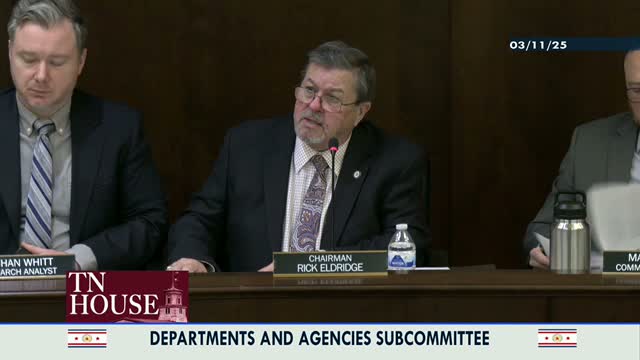
Subcommittee advances bill to reduce private-prison populations after higher death rates; family testimony draws attention
Summary
A Department and Agency Subcommittee bill that would require population reductions at private prisons with death rates double comparable state facilities moved out of committee after family testimony and debate over accountability.
A bill sponsored by Chairman Boyd that would require population reductions at privately run prisons with significantly higher death rates advanced out of the Department and Agency Subcommittee on a voice vote.
The measure would direct the Department of Corrections to reduce the inmate population at a private or county-operated prison contracted by the state by 10% if its death rate is twice that of a comparable Tennessee Department of Correction (TDOC) facility, and maintain reductions until the facility addresses the problems identified. Chairman Boyd said the proposal would codify a process the department sometimes uses informally.
The measure drew extended public testimony from Tim Leeper, whose son died while housed at a CoreCivic facility in Trousdale County. "My son is Kyle Leeper. He turned 25 years old in a private prison in Trousdale Turner. Two weeks after his birthday, he was dead," Leeper told the committee. He described chronic understaffing, limited rehabilitative opportunities and what he called rampant contraband and overdoses at private facilities.
Leeper gave the committee several figures drawn from his review of state data and private investigations: he said there were 144 inmate deaths statewide in fiscal year 2023, that 65 of those occurred in CoreCivic facilities, and that Trousdale had 28 deaths in that year. He also said the private-prison population was roughly 7,600 versus about 18,900 statewide. He identified a pending federal Department of Justice investigation into conditions at some facilities.
Members questioned Leeper and discussed accountability measures. Representative Powers asked what penalties or remedies would provide meaningful oversight; Leeper suggested financial consequences and population reductions to affect operators' bottom lines. Chairman Boyd described the bill as a compromise that would put an existing practice into statute and asked that the measure go to the full committee for further consideration.
The subcommittee approved the measure and moved it to the full committee.
Provisions in the bill and testimony made clear the proposal focuses on private prisons and does not automatically terminate contracts; it would create a statutory trigger tied to comparative death rates and require action when the trigger is met.
The committee heard testimony and took the vote during the same meeting; members asked for additional oversight detail and for contractors and department staff to appear before the full committee.
Votes on the measure in the subcommittee were announced as a positive recommendation to the full committee.