Get Full Government Meeting Transcripts, Videos, & Alerts Forever!
Get email alerts on the State Budget topic
No spam. Unsubscribe anytime.
Georgia House passes $37.7 billion FY2026 budget (HB 68), sends bill to Senate
Summary
The Georgia House of Representatives on March 12 passed House Bill 68, the fiscal year 2026 General Appropriations Bill, by a recorded vote of 171-4 and ordered the measure transmitted immediately to the state Senate.
The Georgia House of Representatives on March 12 passed House Bill 68, the fiscal year 2026 General Appropriations Bill, by a recorded vote of 171-4 and ordered the measure transmitted immediately to the state Senate.
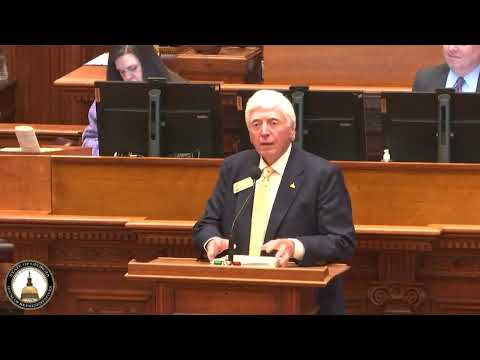
Chairman Hatchett, who presented the bill in the Committee of the Whole, told members the package is “set by [a] revenue estimate of $37,700,000,000 in state funds,” an increase of $1,500,000,000, or about 4.4%, over the FY2025 original budget. “I’ve made no secret about this budget. Things are tight,” he said during the floor presentation.
The bill’s sponsors and the committee described HB 68 as a narrowly expanded spending plan that prioritizes education and public safety while preserving the state’s strong debt position. Key allocations and changes cited by Chairman Hatchett include an increase of roughly $250,000,000 for the Department of Corrections, $9,900,000 to raise the county correctional institution per diem to $30 a day, and $28,500,000 for private prisons to address pay parity and price-index adjustments. The House also added $3,100,000 for a 4% juvenile correctional officer salary increase, about $9,500,000 for additional community supervision officers, and approximately $8,100,000 to offset the loss of federal Victims of Crime Act (VOCA) funding to victim service providers.
On education, the House bill directs additional funds above the governor’s recommendation—roughly $500,000,000 more in education spending over the FY2025 original budget, with about $98,000,000 earmarked for student safety and mental-health initiatives. Hatchett cited a $25,000,000 investment for the Department of Education to work with the Georgia Emergency Management and Homeland Security Agency (GEMA) on new school-safety initiatives, $20,000,000 in mental-health grant funding for middle and high schools, $5,000,000 to hire social workers to address chronic absenteeism, and $10,000,000 for out-of-school programming. The bill also includes $10,000,000 for literacy initiatives, funding for 116 school-based literacy coaches, and $7,500,000 to provide educators with a $100 classroom-supply stipend program approved last session.
The House budget document also captures health and workforce investments including $32,000,000 in Medicaid provider reimbursement rate increases, $8,300,000 in new graduate medical education funding (including $2,800,000 tied to 150 new residency slots and $5,000,000 for grants to support residency programs), nearly $10,000,000 for maternal health initiatives, and $23,500,000 for an enhanced annual COLA supplement for state retirees.
Chairman Hatchett described the House’s approach to capital funding as a partial return to bond issuance after a pause last year. The House agreed to use $545,000,000 in cash for capital projects and shift $321,000,000 of previously recommended cash to be issued as bonds for projects at the Department of Education, the Department of Corrections, and the Department of Juvenile Justice. Hatchett said the House’s recommended bond issuance is roughly one-third of a typical year’s issuance and stressed that Georgia’s constitutional protections and multi-agency bond-rating track record remain in place.
During the floor consideration, members asked questions and offered comments on retirement payments, nursing-home and veterans’ facility funding, Medicaid waiver changes, and private-prison pay parity. Minority Leader Hughley asked how additional payments to the Employees’ Retirement System would work in practice; Hatchett replied that the budget includes roughly $26.5 million for an annual “thirteenth” payment mechanism and said prior supplemental funding is intended to improve ERS funding levels and allow for stronger COLA options. Representative Cannon asked whether the budget contains funding specifically for the Erwin County detention center; Hatchett said no specific line item exists but noted the corrections appropriation could be used in negotiation if the department chose to contract for that facility. Chairlady Dempsey highlighted that mental-health funding is spread across education, corrections, public safety and health accounts.
A motion that HB 68 “do pass by committee substitute” was made on the floor, seconded by Representative Gullett, adopted by voice and then recorded by roll call. The clerk’s final tally on the passage was 171 yeas and 4 nays; the chair declared the bill passed by the required constitutional majority and the House immediately ordered the bill transmitted to the Senate.
The House’s passage is subject to action by the Senate and, ultimately, the governor’s signature. Sponsors described the bill as a “thoughtful spending plan” that uses a mix of cash and limited bond issuance while directing additional dollars to schools, mental-health services, corrections staffing and health-care workforce initiatives.
Votes at a glance: House Bill 68 (FY2026 General Appropriations Bill) — Passed by committee substitute; final House passage recorded as 171 yeas, 4 nays. The House ordered the bill transmitted to the Senate.
(Reporting note: all figures and program descriptions above reflect floor remarks and committee summary presented by Chairman Hatchett during the March 12 House session.)