Get Full Government Meeting Transcripts, Videos, & Alerts Forever!
Get email alerts on the Stormwater topic
No spam. Unsubscribe anytime.
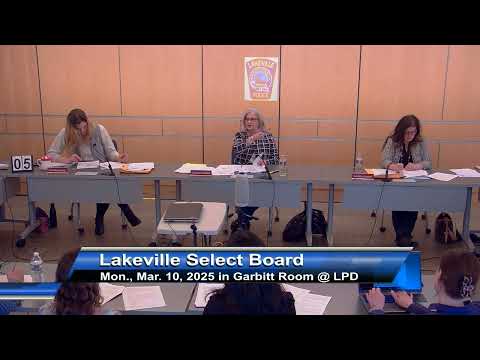
Lakeville reviews expanded stormwater bylaw to meet MS4 permit; select board eyed as enforcement authority
Summary
Town officials and consultants presented a more comprehensive stormwater bylaw to satisfy the municipal separate storm sewer system (MS4) permit, discussed who should serve as the enforcing authority, a new permit and fee structure, and the use of 53G peer‑review accounts to pay for third‑party engineering reviews.
Lakeville officials and consultants reviewed a proposed overhaul of the town’s stormwater bylaw intended to satisfy Massachusetts MS4 permit requirements and add post‑construction runoff controls.
The revisions, drafted by consultants and reviewed by SERPed, add definitions for nature‑based solutions and green infrastructure and would create a permit structure for stormwater projects, possible permit fees, and a mechanism for third‑party peer review using a G.L. 53G account. “The black text is … the consultant template adapted for the town,” said Sarah, a SERPed reviewer, describing the draft provided to the board. The consultants said the revised bylaw is meant to tighten on‑site treatment and to prevent any new discharges into the municipal stormwater system.
Why it matters: The MS4 permit requires towns to limit illicit discharges and control stormwater from development; a new, broader bylaw would give the town a permitting process and clearer enforcement path. The draft also anticipates pending changes to the statewide MS4 permit and adds best‑practice language recommended by reviewers, including Mass Audubon’s bylaw review rubric.
Most substantive points: The consultants and staff discussed who should be the town’s stormwater authority and how enforcement and review would work. Options raised included having the Select Board (or the Select Board’s designee) serve as the authority with a designated stormwater agent (for example, the building commissioner), assigning the responsibility to an existing board such as the Planning Board or Conservation Commission, or contracting a third‑party reviewer paid from a 53G peer‑review account funded by applicants. “If you take this under the custody of the Select Board, I would ask that we establish a 53G account and get a consultant under contract to do reviews and inspections,” said Nate (identified in the meeting as the building commissioner), urging a mechanism that would not rely only on town staff time.
The draft would create a new permit and inspection regime and allow permit fees designed to cover staff time and potentially fund town operations. Consultants explained that the 53G account is an interest‑bearing account established with applicant funds to hire peer reviewers; unused funds are returned to the applicant. They said a sizable permit fee would probably be required to cover operational costs and staff oversight, and that a separate 53G peer‑review deposit would cover consultant review and inspection.
Board members raised recurring concerns about workload and funding. Several Select Board members stressed that inspectional services are already stretched and recommended minimizing the burden on existing staff by funding peer review through applicant deposits. One member asked whether fines and enforcement mechanisms in the draft are actually enforceable; staff said town counsel is reviewing enforcement language and that the draft retains a $300‑per‑day fine provision (included in the packet) but that the town is seeking clearer authority language to ensure fines can be collected and enforced.
Other discussion touched on exemptions and scope. Attendees raised new uses—such as commercial power‑washing or “soft‑washing” with detergents—that have increased in recent years and asked whether those activities should be specifically treated as illicit discharges. The team noted that many such nonstormwater discharges are already covered under the town’s illicit‑discharge bylaw but recommended the new bylaw explicitly address common, modern sources of runoff.
Next steps and timing: Consultants said they will finalize edits for a Planning Board packet; a draft was due to officials by the Wednesday before the Planning Board’s meeting on Thursday the 13th (as announced in the presentation), and Planning Board hearings would follow. If the town pursues the draft bylaw the process will include required hearings and, ultimately, a vote at an annual town meeting to adopt the bylaw.
Speakers (as recorded in the meeting) - Sarah — Consultant, SERPed (presenter/reviewer) - Danica — Consultant/reviewer (participated in bylaw review) - Nate — Building Commissioner (discussed agent role and enforcement) - Michelle — Select Board member (raised administrative/staffing concerns) - Select Board Chair (chairing the Select Board discussion)
Authorities - MS4 permit (municipal separate storm sewer system permit) — referenced by consultants and staff - G.L. c. 53G (peer review/escrow account mechanism) — referenced as "53G account" in discussion - Mass Audubon bylaw review rubric — used as a review tool by consultants
Clarifying details - 53G peer‑review account: applicant deposits funds to pay third‑party review and inspections; unused funds are returned to applicant (described by staff/consultants). - Permit/fee structure: draft would establish a stormwater permit and allow a permit fee intended to cover administrative costs; a large permit fee would likely be required if it also funded 53G activity. - Enforcement/fines: draft packet contains a $300‑per‑day fine provision; town counsel is reviewing enforceability language. - Timeline: a revised draft was scheduled to be to officials by the Wednesday before the Planning Board meeting on Thursday the 13th; Planning Board hearings and then a potential town‑meeting warrant article were discussed.
Provenance - {"block_id":"39.164997-92.18","local_start":0,"local_end":534,"evidence_excerpt":"Is kind of in phases. So in an earlier phase, the town was required to adopt a bylaw specific to illicit discharges...the town is looking to update that current bylaw, with 1 that is more comprehensive","reason_code":"topicintro"} - {"block_id":"743.245-749.345","local_start":0,"local_end":142,"evidence_excerpt":"Yeah. Okay. And this this bylaw the new newly proposed bylaw would establish a permit structure, a new permitting structure for stormwater projects, which could include a fee for that permit...","reason_code":"topicfinish"}
Searchable_tags:["stormwater","MS4","bylaw","serped","53G","peer_review","select_board","environment","infrastructure"],"proper_names":[{"name":"Town of Lakeville","type":"other"},{"name":"Mass Audubon","type":"organization"},{"name":"SERPed","type":"organization"}],"topics":[{"name":"environmental_regulation","justification":"Draft bylaw is aimed at MS4 compliance and stormwater management","scoring":{"topic_relevance":0.95,"depth_score":0.80,"opinionatedness":0.05,"controversy":0.40,"civic_salience":0.85,"impactfulness":0.65,"geo_relevance":1.00}}]},{