Get Full Government Meeting Transcripts, Videos, & Alerts Forever!
Get email alerts on the Farmer Program Agricultural Replacements topic
No spam. Unsubscribe anytime.
Ventura County approves $694,806 in FARMER program grants for agricultural equipment replacements
Summary
The board approved eight projects under the FARMER program with total grant awards of $694,806 and total project costs of $1,015,026; staff explained how funds are allocated across programs and communities.
The Ventura County Air Pollution Control Board approved eight agricultural off-road equipment replacement projects under the Funding Agricultural Replacement Measures for Emission Reductions (FARMER) program, with total grant awards of $694,806 and total project costs of $1,015,026 including applicant cost share.
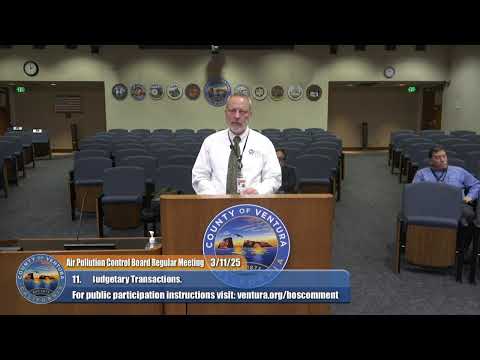
Tyler Harris, division manager, said staff received 116 total incentive-program applications across programs in 2024 and that applicants requested funding to replace 154 pieces of diesel agricultural equipment, seven diesel off-road pieces not agricultural, three diesel school buses, and to install five electric charging projects totaling 45 charging stations. "Total grant funding requested by applicants was $31,856,709. Today we are requesting board approval of 8 qualified agricultural off road equipment replacement projects through the FARMER program with a total grant value of $694,806 and a total cost of $1,015,026 including the applicant cost share," Harris said.
Harris said the district will also use DMV fee funds authorized through Assembly Bill 923 to partially fund one of the projects. He reported that of the eight projects and 13 pieces of equipment proposed, three projects with seven pieces of equipment are located in California-designated disadvantaged and low-income communities, and the remaining five projects and six pieces of equipment are in California-designated low-income communities.
Board member Long asked whether the allocation that resulted in 53.8% of funds going to communities classified as both disadvantaged and low income and 46% to low-income communities was by design or how it "just fell out." Harris explained the district pools projects across several incentive programs and assigns funds to meet percentage requirements in the CAP and FARMER programs while ranking projects by cost-effectiveness. "We just make sure that we meet those percentage requirements," Harris said, describing the district's approach to prioritizing school buses for CAP funds and using remaining funds for agricultural projects when cost-effective.
No members of the public registered to speak on the item. The board voted to approve staff recommendations, direct the APCO to prepare grant agreements for approved projects, designate redistribution sources for FARMER projects as needed, and authorize the auditor-controller to process transactions. The motion passed unanimously.
District staff will administer the grant agreements, ensure contract requirements are met prior to payments, and monitor completed projects for the life of each grant agreement.
Background: FARMER provides funding to reduce emissions from agricultural sources. The district reported this is the seventh year it has administered the FARMER program locally.
Next steps: Staff to prepare grant agreements for each approved project and return as needed for program administration and reporting.