Get Full Government Meeting Transcripts, Videos, & Alerts Forever!
Get email alerts on the Open Government topic
No spam. Unsubscribe anytime.
Committee advances bill to remove population thresholds from Minnesota public data law
Summary
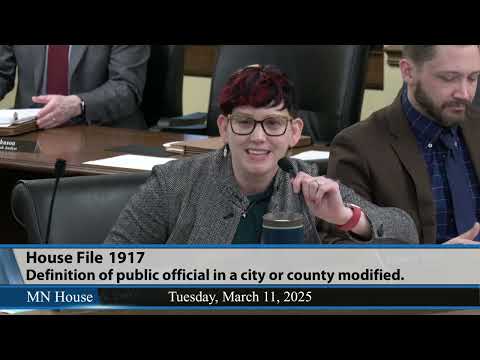
The House Judiciary Finance & Civil Law Committee recommended re-referral of House File 19-17 to the Committee on Election Finance and Government Operations, a bill that would remove population cutoffs that currently limit public access to certain complaint-related records about local officials.
The House Judiciary Finance & Civil Law Committee on Monday recommended re-referral of House File 19-17, a bill that would remove population-based thresholds from Minnesota's public data law and make certain records about local public officials available regardless of city or county size. Representative Paul Anderson moved the bill; the committee advanced it by voice vote and sent it to the Committee on Election Finance and Government Operations.
Supporters said the change would equalize public access across the state. "This population based distinction is arbitrary and should be corrected," Matt Ealing of Minnesotans for Open Government told the committee, arguing that citizens in smaller communities are disadvantaged when the definition of a public official depends on city or county population.
The bill and testimony trace the issue back to the law's evolution: historically the personnel provisions applied to state employees, and a 2012 amendment applied some disclosure rules to local officials but added population thresholds. Under current language cited by supporters, the public-official definition applies to "cities over 7,500 or counties over 5,000," which supporters say allows residents of larger cities to obtain the underlying data of complaints in some circumstances while smaller communities cannot.
Committee members pressed for practical details and possible costs. Representative Finke, whose district includes small cities such as Lauderdale and Falcon Heights, asked what would change in practice for very small municipalities. Tori Key, an intergovernmental relations representative with the League of Minnesota Cities, replied that the aggregate impact is difficult to quantify and that smaller cities often have limited staff who currently handle many types of data requests. "We're looking at it from the holistic point of view of the number of data requests that are coming in across the state," she said, noting small cities often have one staff member responsible for many duties.
House Research and committee counsel provided context about why the size thresholds exist. Mr. Hopkins explained that some parts of chapter 13 apply differently based on jurisdiction size because compliance can be a burden for smaller governments and because closer-knit communities may have less perceived need for mandated transparency.
Supporters emphasized narrowness of the circumstances that make records available: generally a complaint or charge must exist and certain personnel thresholds must be met before the exception applies. "You're not talking about an endless amount of data," Ealing said, adding that the public interest includes knowing when taxpayer money is used for settlements or buyouts.
Representative Anderson cited a motivating example involving the city of St. Joseph and said his constituents in small towns want the same access to information as residents of larger cities. After discussion and no additional public testimony, the committee approved re-referral to Election Finance and Government Operations by voice vote.
The bill removes population cutoffs from the statutory definition (testimony referenced removal of the population numbers on "page 3, line 8 and 9") and will now be considered by the receiving committee; no timetable for further action was specified at the hearing.