Get Full Government Meeting Transcripts, Videos, & Alerts Forever!
Get email alerts on the Waste Management topic
No spam. Unsubscribe anytime.
Eau Claire council debates options for trash collection: single hauler, municipal service, zones and composting
Summary
Staff reviewed a year-long study of the city’s open-market trash system and presented options including minor ordinance changes, district contracting, a single hauler, or full municipalization; councilmembers and local haulers weighed in on costs, equity and environmental goals.
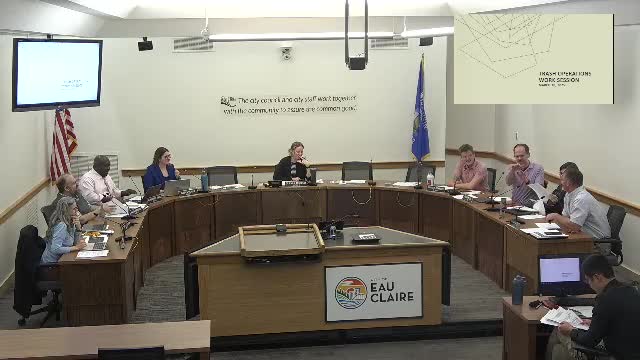
City staff led a work-session discussion March 10 on options to change residential trash collection in Eau Claire after a Wisconsin Policy Forum study compared the city’s open-market system to peer communities.
Staff summarized the study, public feedback and operational complaints since the pandemic. They said the system’s complaint profile has shifted from missed pickups during staffing shortages to neighborhood-quality complaints—trash storage visibility and unsecured containers. Staff noted the pandemic-era service gap: haulers self-reported a 33% miss rate in the second pandemic year and a 0.8% miss rate in the most recent year.
The study found Eau Claire residential trash costs about 30% higher than the study’s peer communities. Staff and council discussed several response options: (1) do nothing and improve the current system; (2) change ordinances to allow biweekly recycling/trash and broaden composting; (3) limit the number of haulers or create licensing/district rules so each zone has a single hauler; (4) have the city contract with one or more haulers and bill as a utility; or (5) municipalize service (city-owned trucks, crews and carts).
Staff emphasized constraints and trade-offs. Municipalizing would require large up-front capital for trucks, carts and a maintenance facility; staff offered rough cost indicators from the discussion: garbage trucks in modern configurations were estimated at roughly $500,000–$750,000 each, and cart procurement for the city’s customer base could run into the low millions. The city’s debt policy (a 3.5% council guideline and a 5% state statutory ceiling was cited) and other planned capital projects—PFAS treatment and wastewater work—limit the city’s bonding capacity.
Smaller haulers and local business owners urged maintaining a competitive market. Jaycee Mullen, owner and CEO of Trash on Trucks, said small local haulers lack the capital to be the sole vendor for a city-wide single-hauler contract and that a single-hauler model could leave only two large nonlocal companies as viable bidders. “If there was a single hauler presented, I believe the majority of us smaller people would be pretty against it,” Mullen said.
Council members voiced a range of preferences. Councilmember Bristow said she would be “very hesitant” about a single-hauler contract and expressed interest in a municipal option that includes provisions to preserve equity for smaller local operators. Several council members favored expanding composting access and adjusting pickup schedules—biweekly recycling or trash pickup—and some suggested zoning the city into districts to reduce the number of trucks on given streets and to limit wear on residential pavement.
Staff flagged several ordinance limitations cited in public feedback: current city code requires weekly pickup (which prevents biweekly collection) and prohibits hauling compost across lot lines (limiting neighborhood drop-off or community compost sites). The health department noted that biweekly collection does not generally create additional human-health hazards if residents bag trash, close lids and are educated on handling biohazards; the department recommended pairing any move to biweekly pickup with stronger diversion programs (composting and recycling) and public education.
Staff outlined next steps: gather further public feedback at a community meeting, meet with the haulers for technical input, bring revised ordinance language to council and, if council directs, prepare more detailed financial modeling for municipalization or a utility-billing option. No formal policy change or vote was taken on March 10; staff said they will return with options and public meeting dates for further council direction.
The meeting drew multiple public speakers on the topic: Mary Anne Cough (neighborhood resident and operator of Earthbound Environmental Solutions) urged repeal of a weekly-pickup ordinance and argued biweekly pickup suits low-waste households; Jaycee Mullen (Trash on Trucks) warned that a single-hauler contract could eliminate small local providers; and others discussed composting, districting and the question of how to fund enforcement and licensing.