Get Full Government Meeting Transcripts, Videos, & Alerts Forever!
Get email alerts on the Housing Development topic
No spam. Unsubscribe anytime.
Miami-Dade committee hears public push for worker protections, affordable-housing guarantees in Swerdlow Group redevelopment
Summary
Community groups, unions and residents pressed Miami-Dade County officials to lock in heat protections, worker safeguards, replacement public housing and small-business supports as part of the Swerdlow Group redevelopment discussed at the March 11 housing committee meeting.
The Miami-Dade County Housing Committee on March 11 heard hours of public comment and follow-up questions from commissioners on a proposed Swerdlow Group redevelopment in Little River/Little Haiti that includes promises of worker heat protections, replacement public housing under RAD and community benefits funding.
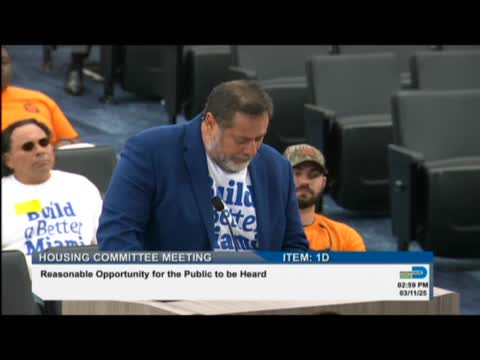
Supporters and construction workers urged the committee to make several developer commitments contractual rather than voluntary. "We're encouraged with this... project that we're referencing in 3a," said D'Angelo, who identified himself as representing carpenters, power drivers and millwrights in South Florida, adding labor wants developer commitments placed in the development agreement. Community organizer Geneva Claus of the Build A Better Miami Coalition asked the committee to earmark $500,000 for the Emergency Rental Assistance Program (ERAP) and $1 million for emergency small-business grants to protect historic neighborhood businesses.
Why it matters: Speakers told the committee that, without enforceable terms, the community benefits and worker protections could be difficult to hold the developer to and that longtime residents and small businesses face displacement pressure as new development moves forward. Several public commenters also pressed staff to clarify replacement-unit counts for public housing and to provide more resident meetings.
What commissioners and developers said: Commissioners praised an announced developer commitment to heat protections for outdoor construction workers while noting state law limits on local heat-safety ordinances. Commissioner Arlene Higgins said she was "very pleased" with the proposed covenant on heat protections and noted there will be additional community meetings. Michael Liu, chief strategy officer and executive vice president for Swerdlow Group, told the committee the company "is certainly willing to engage with the community to talk about economic development" and pointed to what he described as a financial commitment by the developer to the county over the lease term: "9 and a half billion dollars over the life of the... project," Liu said.
Public-housing replacement and tenant concerns: Multiple speakers representing Victory Homes tenants and public-housing resident councils asked for delays so residents could be consulted. Alana Greer of Community Justice Project pointed to a discrepancy the group found: Victory Homes was listed as 148 units in one county document and 144 replacement units in another. "Four units is four families," Greer said, and she reminded the committee that federal law requires one-for-one replacement of occupied and occupiable units. County staff responded that the redevelopment plan contemplates replacing 314 public-housing units across the sites to be redeveloped and said there would be no net loss of public-housing units and no displacement that would require multiple moves.
Worker protections and health: Construction workers and health-care students urged contractual safeguards for wages, verified responsible contractors, on-site medical response during heat events and employer-sponsored health insurance. Ruben Alvarez of We Count and other construction workers described Florida's high incidence of heat-related illness and urged enforceable on-site measures. Medical students from Dade County Street Response supported on-site medical coverage and urged employer-sponsored insurance as a further protection.
Small businesses and community benefit questions: Community members, including Ashley Toussaint of Black Men Build Miami and vice chair of the Little Haiti Trust, asked the county to ensure funds from any revenue-sharing agreement reach small, historic businesses. Speakers urged direct partnerships with local fiscal agents such as the Little Haiti Trust and asked the county and developer to refine how grants or ERAP allocations would be structured and monitored.
Process and next steps: Committee members asked county staff and the developer to hold additional meetings, including resident-specific sessions, to answer outstanding questions. Staff said community meetings were held March 6 and more meetings are planned in mid-March and throughout the redevelopment process. The committee also approved agenda adjustments and forwarded several items to the full Board of County Commissioners for the March 18 meeting; the transcript shows the committee later voted to move the redevelopment item forward after discussion.
Ending: Speakers who urged stronger, enforceable terms said they would continue organizing and requested regular, accessible outreach so residents and small businesses can track the project's milestones and hold parties to written agreements.