Get Full Government Meeting Transcripts, Videos, & Alerts Forever!
Get email alerts on the Homelessness Services topic
No spam. Unsubscribe anytime.
County adopts public-camping ordinance; commissioners add referral-to-services language
Summary
Indian River County commissioners adopted an ordinance to prohibit public camping on county property to comply with a new state law. The board amended staff's draft to add a requirement that law enforcement attempt referrals to local homeless services before penalties are sought; advocates urged stronger ties to coordinated entry and housing
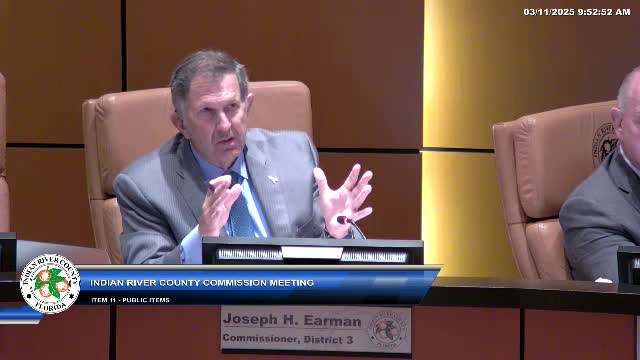
Indian River County commissioners adopted a public-camping ordinance on March 11 intended to bring the county into compliance with recent state legislation. The ordinance prohibits sleeping or camping on county property and public rights-of-way unless a location is formally designated for recreational camping.
Why it matters: The board's action responds to a state law requiring local governments to adopt prohibitions on public camping; commissioners and service providers said the law must be implemented in a way that balances public-safety, property rights and the needs of people experiencing homelessness.
What the ordinance does and how the board amended it County counsel presented a draft ordinance patterned on the state requirement. Counsel said the ordinance is not intended to criminalize homelessness but to avoid civil litigation and to provide county staff and law enforcement clear authority to prohibit camping on government property and rights-of-way. Under the draft, law enforcement must warn an individual and attempt to secure compliance before considering penalties.
During discussion commissioners asked staff to make sure the ordinance allows county administrators latitude during declared emergencies. Counsel and county staff confirmed that emergency declarations made by the governor or the county effectively suspend normal liabilities and that the recently passed state statute exempts certain emergency-declaration circumstances from the legal exposure that prompted the statute.
The board amended the draft before adopting it. Commissioners added language to require that, after a warning and in cases where a person refuses to obey an order to leave, law enforcement "make a referral to community services" (language adopted during the meeting) before pursuing penalties. Counsel said that the referral language should be broad enough to avoid naming specific agencies that might change names, and commissioners and providers recommended routing referrals through the county's homeless continuum of care / coordinated entry system to match individuals to services and available shelter slots.
Public comment and service-provider requests Representatives from Right Life Services, United Way of Indian River County, Charter Coast Homeless Services Council, Hoefer Family Center and other local nonprofits urged the commission to ensure the ordinance enables outreach and connections to housing and behavioral-health resources. Several speakers said adding mandatory referrals to coordinated entry and outreach teams would reduce arrests, lower taxpayer costs and better serve people with serious mental-health or substance-use issues.
United Way's representative emphasized the higher public cost of incarceration compared with shelter and services, while local service providers asked the sheriff's office to call the continuum of care or coordinated-entry intake when deputies encounter people living outdoors.
Board action Vice Chair Law moved to adopt the ordinance as amended to add referral language; the motion carried unanimously. Counsel said staff would incorporate the amended referral language in the final ordinance text and that the county would notify local providers to coordinate implementation. Staff also noted that the ordinance includes a warning and referral step and that penalties are discretionary only after attempts to connect the person to services have failed.
What the ordinance does not change Commissioners and counsel repeatedly said the ordinance does not eliminate outreach or services; rather, it aims to provide clear local rules similar to those adopted by other Florida jurisdictions and to reduce county exposure to litigation under the new state law. Counseling from staff emphasized that during state- or county-declared emergencies, authorities can take alternative actions to address immediate shelter needs.
Ending The newly adopted ordinance will be finalized with the committee's referral language incorporated and posted per statutory requirements. Service providers asked the county to adopt referral protocols that connect law enforcement to the coordinated entry system, and county staff said they would work with the providers to operationalize that linkage.