Get Full Government Meeting Transcripts, Videos, & Alerts Forever!
Get email alerts on the Jury Service Exemptions topic
No spam. Unsubscribe anytime.
Committee narrows and advances bill to exempt probation officers from criminal jury service amid opposition from Judicial Council
Summary
AB 387, narrowed to apply only to criminal trials, would exempt probation officers from jury service; supporters said the officers’ continuous court role makes them unsuitable jurors, while the Judicial Council warned categorical exemptions reduce representative jury pools.
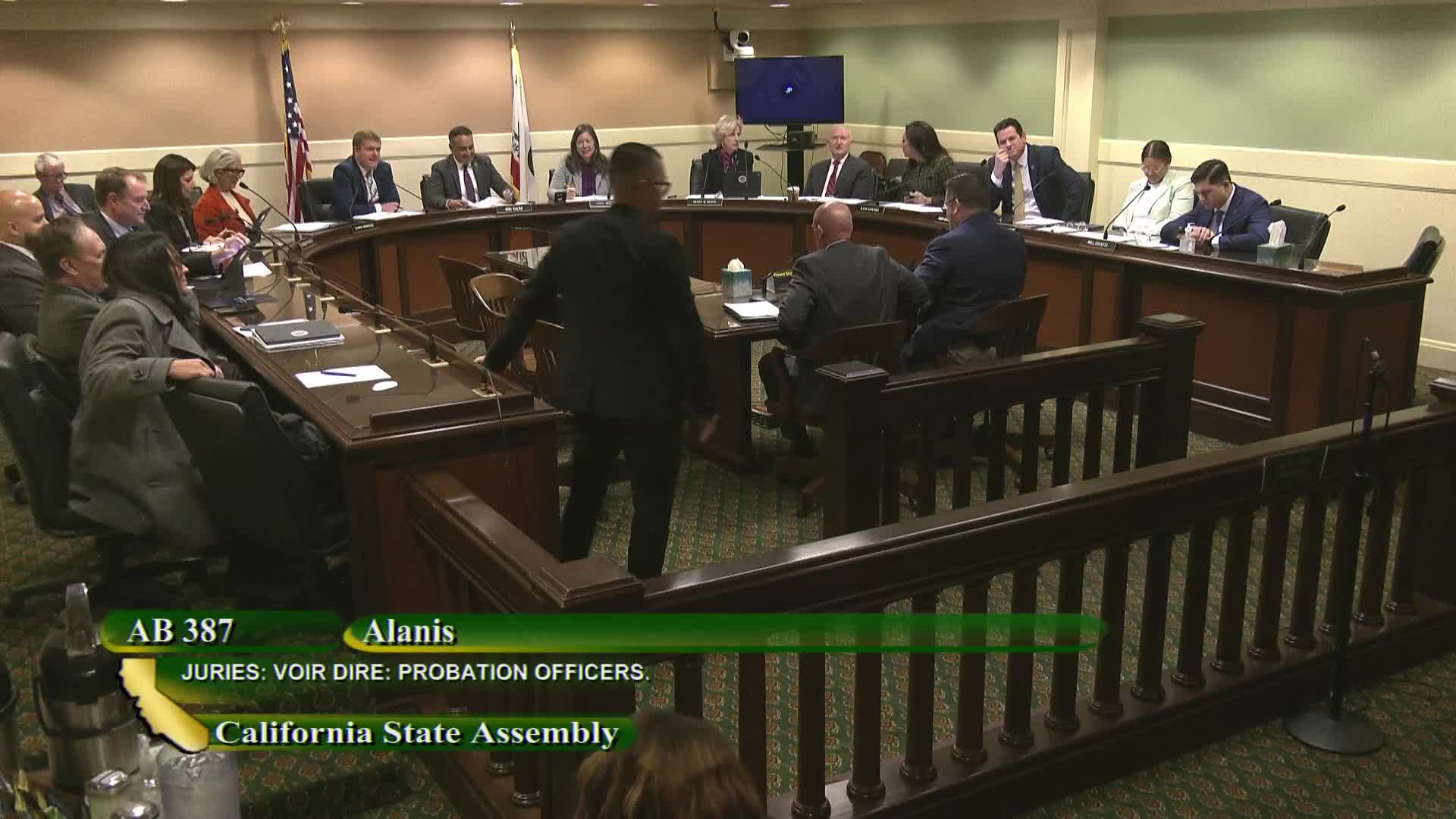
The Assembly Judiciary Committee voted to advance AB 387, a bill that—following amendments—would exempt probation officers from criminal jury service. The committee adopted the narrower version that removes civil cases from the exemption after testimony both for and against the bill.
Assemblymember presenting AB 387 said the bill would remove probation officers from the jury selection process because probation officers are “an arm of the court” and have an ongoing role before, during and after trials, including preparing pretrial and presentence reports, supervising individuals on probation, and running rehabilitative and reentry programs. The author said having probation officers summoned for jury duty “pulls probation officers away from their duties” and “may create a perception of bias.” The author said the bill will save court and probation department time.
Steve Jackson, identified as Chief Probation Officer of San Joaquin County and president of the Chief Probation Officers of California, testified in support and described the probation role across pretrial, sentencing and supervision and said courts often dismiss probation officers from jury pools anyway because of their role.
Opposing the bill, Marie Rasul of the Judicial Council of California said the council “must regretfully oppose Assembly Bill 387.” The council’s written and oral testimony argued that categorical exemptions reduce the available juror pool, make it harder to assemble representative juries, and unfairly increase the burden on other segments of the population. Rasul cited the history of occupational exemptions being narrowed in the 1970s and said the Judicial Council has a longstanding policy opposing categorical exemptions.
Committee members debated precedent and practicality. Some members said probation officers’ continuous involvement in the court process makes them different from other court‑adjacent roles, while others warned that exempting occupations risks creating precedent for further exemptions and could erode jury pools.
Following debate, the committee adopted the amendment narrowing the bill to criminal cases and voted to advance the measure, recording a roll call with mostly affirmative votes.