Get Full Government Meeting Transcripts, Videos, & Alerts Forever!
Get email alerts on the Workday Hr Payroll topic
No spam. Unsubscribe anytime.
Bexar County outlines Workday rollout for payroll and HR; no vote taken
Summary
County staff presented a timeline and training plan for replacing aging payroll and HR systems with Workday; commissioners asked for details on costs, training and policy updates and did not take formal action.
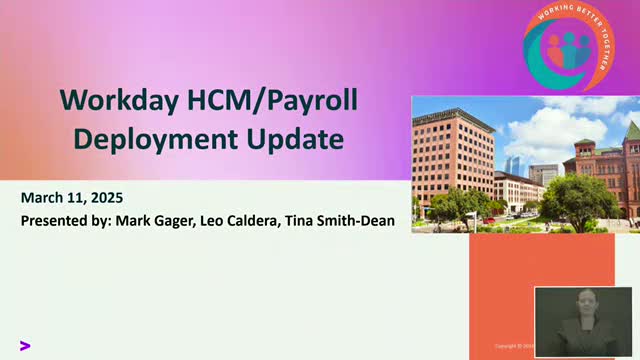
Bexar County officials presented a multi-department plan March 11 to replace legacy payroll and human-capital systems with Workday, saying the change will centralize employee records, timekeeping and benefits and reduce manual payroll processing.
The county’s project lead said the county currently relies on an SAP-based payroll system introduced in 2002 and an older timekeeping system first deployed in 1977, and described Workday as a cloud-hosted system to replace SAP, NeoGov, Benalogic and other local tools. “Employees will use Workday to better manage their information, their benefits, their time off, their pay information,” the presenter said during the briefing.
County staff told the commissioners the project’s goals are to improve data accuracy, speed reimbursements and reduce manual work. Leo Calera, who led discussion of payroll impacts, said the county currently relies on “a 90% manual process” for payroll and that the old systems regularly produced post‑payroll adjustments that staff must recover from former employees. Calera said delays in overtime and reimbursement are recurring problems that Workday should address.
Project staff presented an implementation timeline that places system testing in March, “train‑the‑trainer” sessions in April, broad employee training in May and a go‑live in June 2025. The team described a “train‑the‑trainer” and change‑ambassador model in which offices identify staff who will train coworkers, and said policy updates (for example, leave, FMLA and timekeeping rules) will come to the court before full rollout.
Commissioners asked for fiscal detail and operational consequences. County Manager David Smith and staff said the project budget is about $14 million, most of it an upfront implementation cost, with recurring licensing and support fees afterward. Asked whether the county would save money, project staff said savings would come from reduced paper processing, fewer erroneous payments and faster reimbursement for federally reimbursable work; they did not provide a single, consolidated annual savings figure during the presentation.
Several commissioners praised the adoption but asked for more follow‑up: training demos for smaller offices, written policies tied to the system changes, and assurances that elected officials and exempt employees’ work expectations would be handled appropriately. The court requested a clear schedule for policy changes, confirmation that each office has identified trainers and a plan for employee outreach and technical support.
No formal vote or appropriation was taken on the Workday project at the March 11 meeting; staff said they would return with policy changes, training schedules and follow‑up materials as the project proceeds.
Ending — The county’s Workday implementation is on a compressed schedule for spring 2025 and will require offices to participate in training and policy updates. Commissioners directed staff to provide additional fiscal detail, training demonstrations for offices on request and a list of policy amendments prior to broader roll‑out.