Get Full Government Meeting Transcripts, Videos, & Alerts Forever!
Get email alerts on the Fraud Scams topic
No spam. Unsubscribe anytime.
Minnesota AG warns scams are evolving: social media, gift cards and crypto hamper recoveries
Summary
Attorney General Keith Ellison and Deputy Jessica Whitney told lawmakers that scams are increasingly sophisticated, often originate overseas, and that recoveries depend on traceability and consumer reporting; they suggested policy options including a dedicated restitution fund.
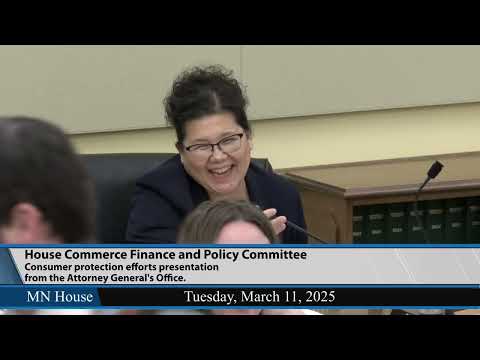
Attorney General Keith Ellison and Deputy Attorney General Jessica Whitney briefed the House Commerce and Finance Policy Committee on March 11 about changes in scam activity, how fraud methods are shifting, and the practical limits of consumer recovery.
Ellison said national consumer data show large aggregate losses: “In 2023, consumers reported losing nearly $10,000,000,000 to fraud,” he said, citing Federal Trade Commission figures. He added that “consumer losses facilitated by social media, totaled 1,400,000,000 in 2023,” and that imposter scams remain common. Whitney described a long‑running pattern of younger cohorts being targeted via online channels and noted new pressures from deep‑fake and AI technologies.
Why it matters: The office said scams are lucrative for perpetrators and inexpensive to operate, which sustains high volumes. When payments move through gift cards or cryptocurrency, or when actors operate outside U.S. jurisdiction, recoveries become difficult or impossible without cross‑border law enforcement cooperation.
Key points from testimony: - Younger adults (30–39) now report more frequent incidents, while older adults (60–69) tend to lose larger sums. Deputy Whitney: “The devastation that fraud... is with the older folks because it takes their life savings out.” - The AG’s office is complaint driven: “We are a complaint driven system,” Ellison said, and encouraged Minnesotans to report scams through the consumer action number he provided. - Cross‑border scams present enforcement challenges. Ellison said the office coordinates with Interpol, the FBI and the National Association of Attorneys General on international tracing. - Methods and money flows shift over time: the office has seen scams move from wire transfers and Western Union, to gift cards, and increasingly to cryptocurrency and bitcoin ATMs.
Recovery and policy options discussed: Deputy Whitney described an idea presented by AARP and others—a dedicated consumer restitution fund seeded from civil penalties that could be used to restitute victims in cases where defendants are unreachable or outside U.S. jurisdiction. She said some sister states are exploring similar approaches and that Minnesota legislators have introduced related proposals.
Committee members asked about recovery rates for large losses and whether the AG’s office tracks full restitution versus partial recoveries. Ellison said the office tracks whether it obtains recoveries but did not have in‑hand aggregate return‑rates for life‑savings losses from international scams; he offered to provide data later.
The AG’s office also highlighted outreach and prevention: it has launched senior education efforts, recommended consumer education in schools, and urged more public reporting to reduce shame‑based underreporting.