Get Full Government Meeting Transcripts, Videos, & Alerts Forever!
Get email alerts on the Medicaid Forecast topic
No spam. Unsubscribe anytime.
DHS February forecast: Medicaid spending rises as waiver, long-term care costs climb
Summary
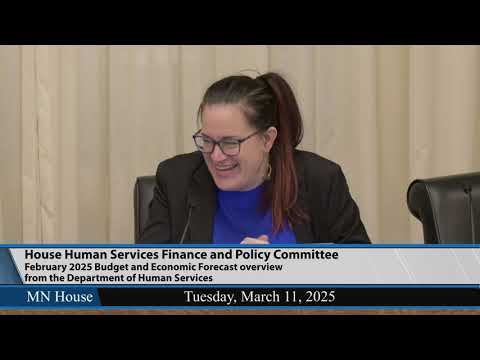
Department of Human Services officials told the House Human Services Finance and Policy Committee that the February 2025 forecast shows rising Medicaid and long-term care costs driven by disability waiver growth, higher acuity in managed care, and a slower transition to a new PCA-related program.
The House Human Services Finance and Policy Committee heard Feb. 11, 2025, from Department of Human Services officials that updated forecast data show rising Medicaid and long-term‑care costs that will increase state spending in the coming biennia.
DHS Chief Financial Officer David Greenman and Budget Director Elise Bailey presented the February forecast and the department’s view of the drivers behind projected increases in fiscal 2024–25, 2026–27 and the planning years 2028–29. “The February forecast reflects changes in projected spending for forecasted programs operated by DHS relative to the projections from the previous November forecast,” Bailey told the committee.
The forecast matters because Medicaid accounts for the bulk of DHS spending and state fiscal exposure: DHS officials told the committee Medicaid covers about 1.2 million Minnesotans and amounts to roughly $20 billion in annual payments to providers, with the federal share about $13 billion a year. Bailey said about 55% of DHS funding for fiscal 2026 is projected to come from the federal government and roughly 37% from the state general fund.
Key drivers cited by DHS include faster growth than expected in disability waiver spending, higher average payments and paid days in nursing facilities, and changes tied to program transitions.
- Disability waiver programs: Bailey said projected inflationary adjustments and higher average payments for disability waiver services push up forecasted spending. DHS estimates the waiver changes add about $35 million in the current biennium, $160 million in 2026–27 and $141 million in the planning years. Bailey also said the number of children and youth on the developmental disability waiver is growing and contributed to the upward revision.
- Long-term care and nursing facilities: Bailey described higher average operating payment rates and an increase in paid days versus prior expectations. The department quantified about $9 million in additional state cost in the next biennium and $11 million in the planning years tied to those long‑term‑care trends.
- Community First Services and Supports (CFSS) and PCA transition: DHS said the principal personal care assistance program is transitioning to CFSS, a change that should allow a higher federal match over time. Bailey said the transition has been slower than anticipated, and that slower uptake — together with a higher take-up of a state‑funded parent and spousal caregiver option — increases costs in the near term. DHS estimated about $20 million of additional state spending in this biennium and $9 million in 2026–27 for those transition effects.
- Managed care and fee‑for‑service payments: DHS reported higher-than-expected average payments in fee‑for‑service and updated capitation payments for managed care organizations because of increased acuity following the Medicaid “unwinding” process. The department estimated a $31 million increase in fiscal 2024–25 tied to updated enrollment and acuity, after the period during which continuous coverage requirements ended.
DHS officials emphasized that the forecast is based on current state and federal law rather than predictions about future policy changes. Greenman told the committee the forecast “is based on state and federal law. We don't try to predict what's going to happen in the future,” but he added DHS is watching federal developments that could affect Medicaid funding.
Committee members pressed DHS for more detail about how enrollment and residency are verified, workforce shortages tied to long‑term care, and where the state can find efficiencies. Representative Backer raised concerns about verifying that enrollees are Minnesota residents; Bailey and Greenman said verification is an active concern and the department would follow up with specifics on procedures. Several members urged using IT modernization and improved systems, including work on SSIS, to reduce inefficiencies.
DHS told members the agency is preparing more analytic materials and a forecast summary that itemizes one‑time versus ongoing changes. Members and DHS staff agreed to continue follow-up, including detailed requests on PCA/CFSS counts and on county IT modernization status.
The committee spent roughly an hour and 15 minutes on questions following the presentation and recessed with follow‑up work planned.
Votes at a glance: The committee approved the minutes from the March 6, 2025, meeting by voice vote at the start of the session; no roll‑call tally was recorded in the transcript.