Get Full Government Meeting Transcripts, Videos, & Alerts Forever!
Get email alerts on the Noncompete Regulation topic
No spam. Unsubscribe anytime.
Committee advances bill to restore limited noncompete agreements for some R&D and highly paid employees
Summary
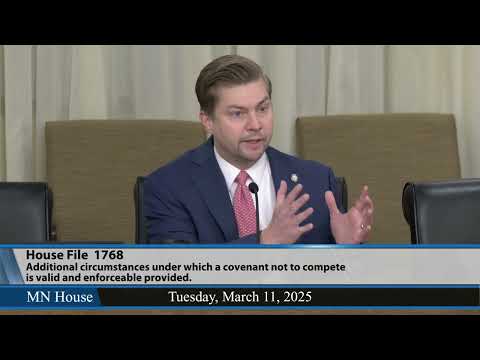
The Minnesota House Workforce, Labor and Economic Development Finance and Policy Committee voted 7‑6 to re‑refer House File 1768 to the general register after two hours of testimony and debate on a proposal to narrow the state’s 2023 ban on noncompete agreements.
The Minnesota House Workforce, Labor and Economic Development Finance and Policy Committee voted 7‑6 to re‑refer House File 1768 to the general register after two hours of testimony and debate on a proposal to narrow the state’s 2023 ban on noncompete agreements.
Proponents, led by the bill’s author Representative Nieska, said the bill restores a narrowly tailored ability for employers and some employees to negotiate noncompete provisions for positions that involve research and development or the creation, analysis or modification of confidential, proprietary or trade‑secret information. “Companies that want to do research and development and innovation in Minnesota need to have the tools to protect their trade secrets,” Representative Nieska told the committee during her presentation (transcript). The measure would allow such agreements for employees whose annual budgeted compensation meets an income threshold specified in the bill; it also creates a separate carve‑out for employees with compensation above $500,000.
The bill drew sharply divided testimony. Business groups — including Lauren Shothorst for the Minnesota Chamber of Commerce and Kurt Zellers for the Minnesota Business Partnership — said a blanket prohibition made Minnesota less competitive for R&D employers and that carefully limited noncompetes remain a reasonable tool to protect trade secrets. “Wage thresholds can protect lower‑wage employees and support worker mobility while applying targeted noncompete provisions to highly compensated employees in roles directly involved in research, development and trade secret management protects vital business interests,” Shothorst said.
Opponents included researchers and antitrust experts who said empirical work shows noncompetes suppress wages, reduce new business formation and harm competition. Hannah Garten Monheit of the American Economic Liberties Project and Bridal Collacci of the Open Markets Institute urged the committee to keep the 2023 ban intact, arguing trade‑secret law, nondisclosure agreements and non‑solicitation covenants are better tools for employers. “Noncompetes prevent free and fair competition,” Garten Monheit said, citing Federal Trade Commission work and public comments collected during the FTC review.
Health care witnesses also urged caution. Dr. Shanna Neil, a family physician representing the Minnesota Academy of Family Physicians and the Minnesota Medical Association, said the bill as drafted could apply to health‑care practitioners who earn over the bill’s compensation threshold and could reduce access to care in rural and underserved communities by limiting physician mobility.
Throughout member questions, committee members pressed staff and the bill’s author on several drafting points the committee had not yet resolved. Nonpartisan staff confirmed the bill contains no definitions for “annual budgeted compensation,” for the statutory terms “proprietary,” “confidential” or “research and development,” and recommended those terms be clarified. Representative Pete Johnson asked whether fringe benefits such as employer‑paid health insurance would count toward the compensation threshold; staff said the bill does not define the term and that clarification would be needed. Representative Greenman and others pressed why trade‑secret law was insufficient; Representative Nieska and other supporters said trade‑secret cases can be difficult to prove and that a noncompete is intended as an additional, narrowly targeted tool for particular functions where confidential know‑how resides in a worker’s experience.
The committee voted by roll call to re‑refer the bill to the general register. Chair Baker cast the chair’s aye vote. Roll‑call votes recorded in the transcript: Chair Baker — aye; Mackland — aye; Bakeburg — aye; Wayne Johnson — aye; Mueller — aye; Schultz — aye; Zales Makar — aye; Berg — no; Fraser — no; Greenman — no; Hussain — no; Pete Johnson — no; Koslowski — no. The committee chair announced the tally as 7 ayes, 6 nays, and the bill was re‑referred to the general register.
Next steps: Committee members suggested the author and interested members continue negotiating definitions and scope to narrow the bill’s reach, especially to avoid unintentionally capturing typical health‑care or lower‑wage roles. Representative Nieska said she is open to working with colleagues on thresholds and definitions prior to further consideration.
Votes and formal action recorded Motion: Chair moved to re‑refer House File 1768 to the general register. Outcome: approved by roll call, 7 ayes, 6 nays. (Roll call names recorded in transcript.)