Get Full Government Meeting Transcripts, Videos, & Alerts Forever!
Get email alerts on the Automated Speed Enforcement topic
No spam. Unsubscribe anytime.
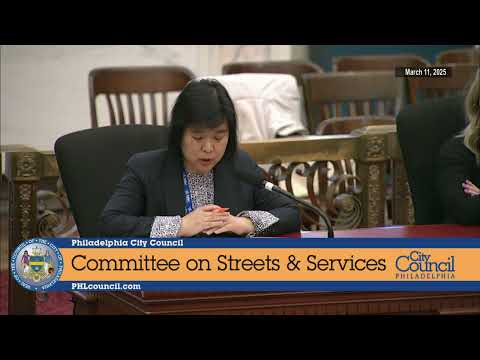
Committee holds vote on automated speed‑camera pilot for seven school zones after members press for more community engagement
Summary
Bill 250148, which would authorize automated speed enforcement in up to seven school zones (with five active at once) as a five‑year pilot, was held to the call of the chair after witnesses described site selection and effectiveness while several council members pressed officials for more community outreach and equity analysis.
The Committee on Streets and Services heard extensive testimony on bill 250148 — an ordinance amending Chapter 12-3400 of the Philadelphia Code to authorize automated speed enforcement in specified school‑zone routes — but the committee did not advance the bill. The chair announced the item would be held to the call of the chair.
Cole Appelman, transportation policy analyst at the Office of Transportation and Infrastructure Systems (OTIS), described the pilot as permitting automated speed enforcement “for up to 7 total school zones, with up to 5 allowed to be active at once. This pilot will last for 5 years before reevaluation as stipulated by PennDOT.” Appelman said the seven schools selected were Visitation BVM, John B. Stetson Middle School, KIPP North Philadelphia Academy, Widener Memorial School, Northeast High School, High School of the Future, and William L. Sayre High School.
Appelman cited previous city deployments as evidence of effectiveness: “In the years since, we've seen remarkable progress on the boulevard, including a 95% reduction in speeding violations, 50% reduction in pedestrian involved crashes, and a 21% reduction in all fatal and serious injury crashes.” He said the pilot would include a 60‑day driver warning period and public education, and that cameras would be active only when school flashers are on with clear signage.
Support testimony included Peter Kim, a volunteer with Fifth Square and a parent, who said Fifth Square “wholeheartedly supports bill 250,148” and cited safety data: “In 2024, Philadelphia experienced 125 deaths resulting from car crashes, and almost half of those lives lost were people walking.” Kim cited the city’s 2023 Vision Zero report and said University of Pennsylvania researchers found speed cameras on Roosevelt Boulevard “save nearly 1 life every month.”
Concerns and committee questioning: Several district council members pressed officials for earlier and deeper community engagement, particularly in neighborhoods where residents — not just school staff or students — will receive fines. Council Member Brooks asked what steps were taken “to ensure that the cameras and the ticketing process does not have inequitable outcomes?” Appelman pointed to a prior equity study and said OTIS would provide supporting reports and analysis. Council Member Brooks and others requested the full data and methodology used to select the seven sites.
Council Member Bass urged caution and recommended holding the bill until district members receive fuller briefings: “I did not know about these plan changes in my district ... I will be the one who will be held accountable for them ... I'm gonna ask mister chairman that we may consider, holding the bill until we get further clarification,” Bass said.
Outcome: The chair announced that bill 250148 would be held to the call of the chair; no committee vote to report the bill was taken. Committee members asked OTIS to provide the full analysis and to start community outreach before the bill advances.
Why it matters: The ordinance would authorize automated speed enforcement near schools — a high‑visibility public safety intervention that proponents say reduces speeding and serious crashes while some council members and community members worry about equity, notice and impacts on residents who will receive citations.
Next steps: Officials said they will provide the committee with the crash‑and‑speed‑data analysis and additional equity materials; the committee will hold the bill to the call of the chair pending those follow-ups and additional community engagement.