
Evergy outlines $17.5 billion capital plan, new gas and solar builds to meet rising demand
Get AI-powered insights, summaries, and transcripts
Sign Up Free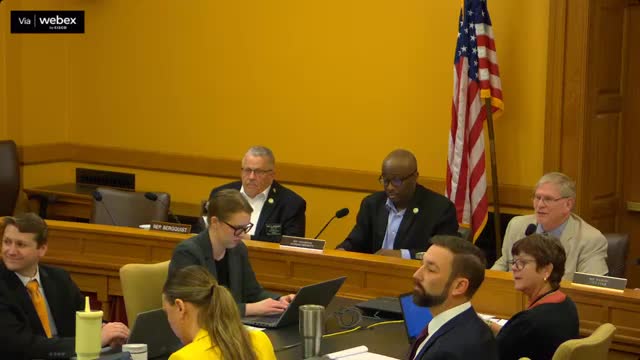
Summary
Evergy told a Kansas House committee it plans roughly $17.5 billion in capital spending from 2025–29, emphasizing natural-gas dispatchable generation, transmission upgrades and utility-scale solar to support strong industrial and data-center demand.
David Campbell, chief executive officer of Evergy, told a Kansas House committee that the company will pursue a multibillion-dollar investment program to preserve affordability while meeting sharply rising electricity demand.
Campbell said Evergy expects about $17.5 billion in capital investment from 2025 through 2029, with roughly one-third of that total funding new generation and nearly half devoted to transmission and distribution improvements. He said the utility has announced multiple new gas-fired plants in Kansas and is planning utility-scale solar projects in both Kansas and Missouri.
The spending program, Campbell said, is designed to balance “affordability, reliability, and sustainability” — the three priorities he said guide Evergy’s strategy. He told committee members that savings produced after the 2018 merger of legacy utilities have helped hold down rate increases for Kansas customers even as the company invests in new infrastructure.
Campbell said the company’s planned generation portfolio additions include combined-cycle natural-gas units expected to enter service in 2029 and 2030, with one site identified near Viola in Sumner County and another near Hutchinson in Reno County. He said the construction cost for a plant of the announced size is “upwards of $1,500,000,000,” and noted tariffs or commodity-price changes could raise that figure.
Chuck Hazely, an Evergy operations and customer-service executive, told the committee the company is seeing an historic level of demand growth from large industrial customers and data centers. He said Evergy’s current summer peak across its system is about 10.6 gigawatts and that the company’s economic-development pipeline represents about 11.2 gigawatts of prospective new load — a level that, if fully realized, would roughly double the company’s current peak within several years.
Hazely cautioned the committee that the company cannot serve all prospective projects but described five large announced projects — including Google, Panasonic and Meta facilities — that together represent about 800 megawatts of new demand. He said such large customers help spread fixed costs and can put downward pressure on rates if the customers contribute appropriately to the incremental system costs needed to serve them.
Campbell and Hazely emphasized that much of the near-term generation build will be dispatchable natural gas because the region needs resources that can be turned on when intermittent wind or solar output is low. Campbell said the company still plans to add wind and utility-scale solar where locally permitted and economic, and noted Evergy currently lacks significant utility-scale solar capacity.
Other figures cited during the presentation included a 27% reduction in “total cost” between the legacy companies’ 2018 baseline and 2024, a near-20% reduction in headcount since the 2018 merger, and Evergy’s filing this year for a rate increase for its Kansas Central service territory of about 8.62% (Evergy said it does not expect to receive the full requested amount). Campbell said the Kansas Corporation Commission will report on regional rate trajectories and that the company acquires data from the U.S. Energy Information Administration for national comparisons.
Committee members asked about conversion of older coal units to gas; Campbell said conversions are possible and in some cases practical where gas pipeline infrastructure already exists, but he warned that converting a large coal boiler to burn gas typically produces a slower-ramping, high‑cost unit best suited as a capacity or bridging resource.
Campbell also described regional reliability concerns reported by the North American Electric Reliability Corporation and said Evergy is planning resources in part to respond to regional dispatchable‑generation shortfalls. He described the planned investment as an intergenerational build — assets with 30–40 year lives that will be paid over time by customers.
Evergy also described customer-service metrics: the company reported an average outage duration in the 90–95 minute range in recent years and said call‑center performance improved in the most recent year, with 70% of calls answered within 120 seconds.
The presentation included a discussion of the company’s investor-facing earnings trajectory and the need to balance returns that attract capital with rate impacts on customers.
Campbell and Hazely answered committee questions before the meeting moved to other business.
Ending: The utility presentation concluded with committee discussion of regulatory approvals required for the new plants and ongoing rate‑case and tariff work; company officials said regulatory reviews, interconnection and permitting remain pending and that company decisions to proceed will depend on those proceedings.