Get Full Government Meeting Transcripts, Videos, & Alerts Forever!
Get email alerts on the Disability Support topic
No spam. Unsubscribe anytime.
Committee holds first hearing on 'Keith's Law' to create voluntary statewide disability registry for first responders
Summary
The Ohio House Community Revitalization Committee held a first hearing on House Bill 144, known as "Keith's Law," which would create a voluntary statewide database allowing people with disabilities to share information with police, fire and emergency medical personnel ahead of crises.
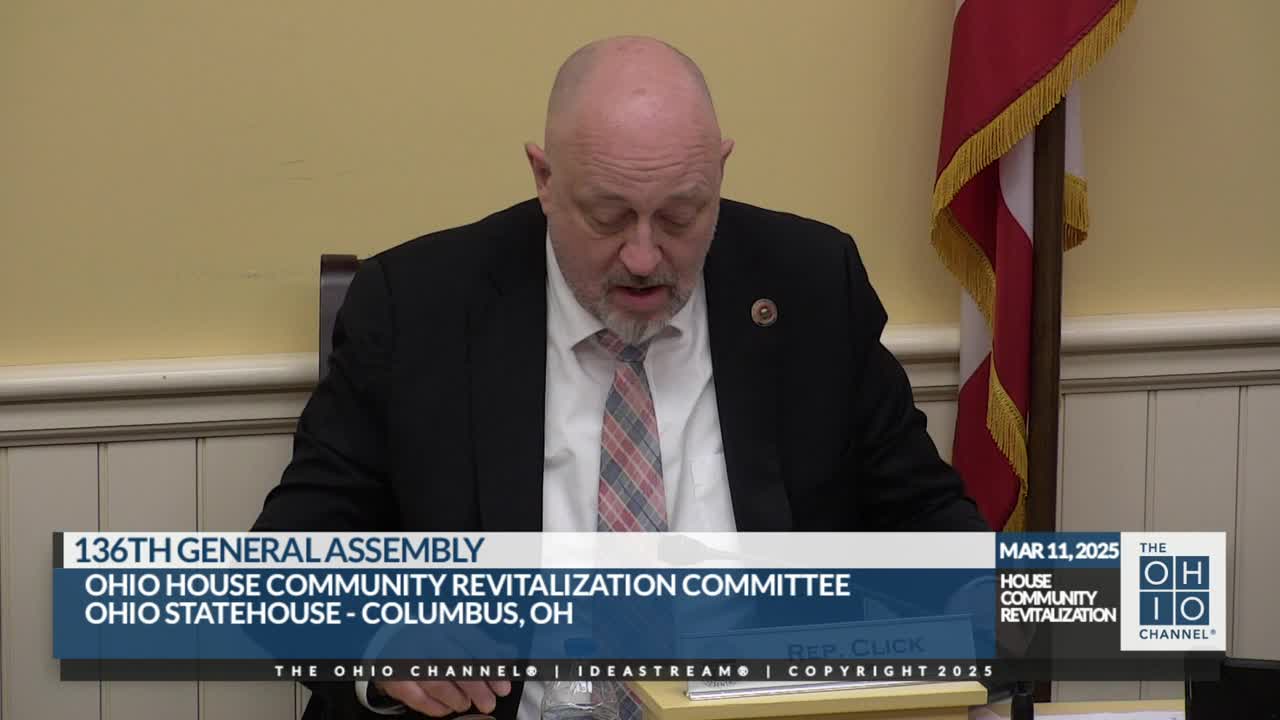
The Ohio House Community Revitalization Committee held a first hearing on House Bill 144, known as "Keith's Law," which would create a voluntary statewide database allowing people with disabilities to share information with police, fire and emergency medical personnel ahead of crises. Representatives James Klick and Mike Bruins offered sponsor testimony and described the proposal as a way to extend existing local registries statewide.
The bill’s sponsors told the committee the database would be voluntary and designed to be accessible across county lines so that information entered in one county could be available to first responders elsewhere. "Keith brought this to me," Representative Klick said during his testimony, "and he said, well, I've tried several times to get someone to take this up and to do this on a statewide basis, but no one will take it up." Klick described the bill as a response to patchwork local registries and said the intent is to allow counties’ 911 systems to receive the information when relevant.
Sponsor testimony highlighted real-world incidents that advocates say the registry would address. Representative Klick described an episode in which an Ohio resident with high anxiety was mistaken for being intoxicated during a traffic stop. Klick also said the database would build on an existing statewide registry for communication disabilities and would expand to include other types of disabilities. "This dog is not trained to attack or to search for drugs. Its singular mission is search, rescue, and comfort," Klick said while describing a specially trained search-and-rescue dog associated with the bill’s namesake, Keith Jesse.
Representative Mike Bruins, a joint sponsor, described the bill’s goal as ensuring first responders have more information when they respond: "This bill is geared towards ensuring that our police, fire department, and emergency medical services have as much information as possible when responding to situations," Bruins said, adding that the registry is voluntary and intended to help planning and de-escalation.
Committee members asked how the registry would be funded and how it would interact with training and alternative response models. When Representative Brownlee asked whether the bill included increased spending, a sponsor replied, "There are no appropriations with this bill." Ranking Member Brewer urged that any registry effort be paired with de-escalation training for officers and suggested exploring alternative community response teams; another member noted an amendment in the budget related to community response teams that could link to the registry’s use in non-police responses.
Sponsors said the Opportunities for Ohioans with Disabilities (OOD) would help maintain the registry alongside the Ohio Department of Public Safety, and that the registry information would be forwarded to each county's 911 systems and frameworks. The sponsors and members emphasized that the registry would be voluntary and that local counties already operate similar systems in some places, such as Hamilton and Delaware counties, but that those local systems do not currently share information statewide.
No committee vote was taken on House Bill 144 during the hearing. Earlier in the meeting the committee approved minutes from a previous meeting "without objection." The hearing concluded after questions and additional comments from committee members.
If advanced, the bill would require further committee consideration and any implementation would depend on cooperation from county 911 systems and participating agencies. Sponsors and committee members said additional work — including possible training mandates or budget language tied to community response teams — could follow in later discussions.