Get Full Government Meeting Transcripts, Videos, & Alerts Forever!
Get email alerts on the Ohio Tourism Economy topic
No spam. Unsubscribe anytime.
Ohio tourism leaders tell House committee advertising and lodging taxes drive visitor spending
Summary
Representatives of TourismOhio, the Ohio Travel Association, hotel and lodging, restaurant and CVB groups told the Arts, Athletics and Tourism Committee that tourism generated tens of billions in economic activity in 2023 and urged continued marketing investments and protection of lodging‑tax funding that supports destination marketing.
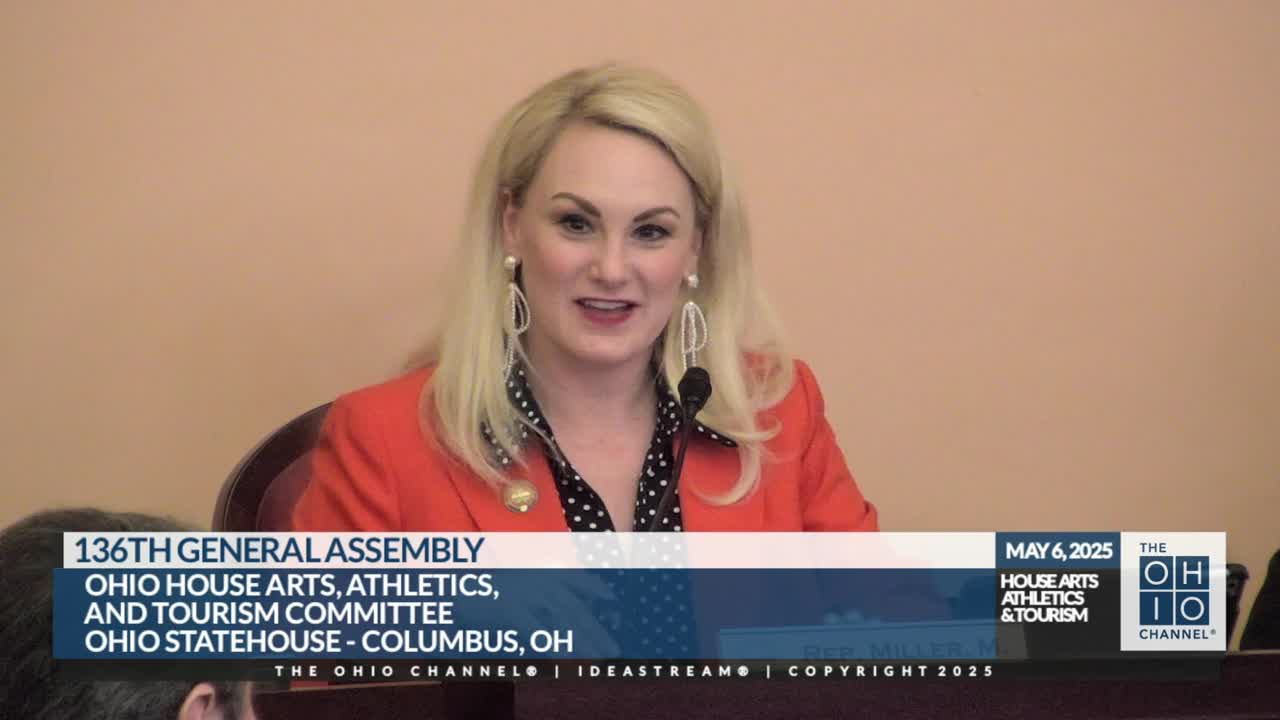
Four tourism-sector leaders told the Ohio House Arts, Athletics and Tourism Committee that continued investment in marketing and preservation of local lodging-tax funding are critical to maintaining visitor spending, jobs and local tax revenue across the state.
Melinda Huntley, executive director of the Ohio Travel Association, summarized 2023 statewide tourism figures and the effect of destination advertising. "In 2023, visitors spent $43,000,000,000 during their travels," she said, and added that businesses supporting those visitors spent another $13,000,000,000 on goods and services, creating a combined $56,000,000,000 economic boost to Ohio. Huntley said tourism supports nearly 436,000 jobs and that 2023 visitor spending generated roughly $4.6 billion in state and local taxes.
Huntley highlighted TourismOhio’s advertising return on investment, saying the agency’s 2023 campaign generated 703,000 trips and more than $217,000,000 in visitor spending and produced nearly $16,000,000 in incremental state and local taxes. "For every dollar invested in TourismOhio's campaign," she told the committee, "$60 in direct visitor spending and $5 in state taxes are generated," she said.
Joe Savaris, president and CEO of the Ohio Hotel and Lodging Association (OHLA), described the lodging sector’s role in funding destination marketing. He said Ohio is home to more than 1,600 licensed hotels and more than 142,000 rooms and that the lodging industry directly employs more than 36,000 people and supports about 184,000 hotel-related jobs statewide. He told the committee hotels produce substantial business sales and tax revenue for state and local government, and he urged preservation of the current lodging-tax model that channels a share of local lodging taxes to convention and visitors bureaus (CVBs).
Savaris warned that layered local lodging taxes can reduce competitiveness and said the lodging sector should have strong input into how lodging taxes are used locally. He asked lawmakers to support tax parity and to avoid changes that would weaken the existing model of using lodging taxes to fund destination marketing.
Todd Bowen, managing director of external affairs and government relations for the Ohio Restaurant and Hospitality Alliance, told the committee that restaurants are integral to the visitor experience and that Ohio’s restaurants and food service businesses employ hundreds of thousands of Ohioans. He said spending in restaurants amplifies tourism’s economic effects and called restaurants ‘‘integral to what makes Ohio a great place to visit, work, live, and raise a family.’’
Andy Herff, executive director of the Ohio Association of Convention and Visitor Bureaus, explained CVB funding and governance. He said local lodging taxes, often layered by city and county, fund CVB marketing and that CVB boards typically include local government and tourism-industry representatives. "Because CVB funding is directly tied to the lodging tax," he said, "a positive feedback loop is created: strong marketing generates more lodging tax revenue, which expands CVB budgets."
Herff noted that CVBs are audited by the state auditor and that many local lodging taxes were established under sections of Ohio law that specify how revenue is shared with CVBs. He referenced state code in testimony (citation given during remarks) and urged lawmakers to keep as much lodging-tax revenue flowing into tourism promotion as possible to grow the visitor pie rather than raising tax rates.
Committee members asked panelists about what visitors want, the role of collaboration across communities, and how Ohio compares with neighboring states on incentives and funding for major events. Panelists told lawmakers that Ohio’s offerings are diverse and that attracting large events often requires competitive state and local marketing, incentive funds and infrastructure. Several members praised the sector and encouraged coordination to package Ohio attractions for different audiences.
No formal legislative action was taken during the hearing. The committee concluded after the roundtable and encouraged members to attend Ohio Tourism Day on the Statehouse lawn the following week.