Get Full Government Meeting Transcripts, Videos, & Alerts Forever!
Get email alerts on the Civics Education topic
No spam. Unsubscribe anytime.
Senate committee debates civics bill aimed at ‘fostering American identity’; holds measure for a week
Summary
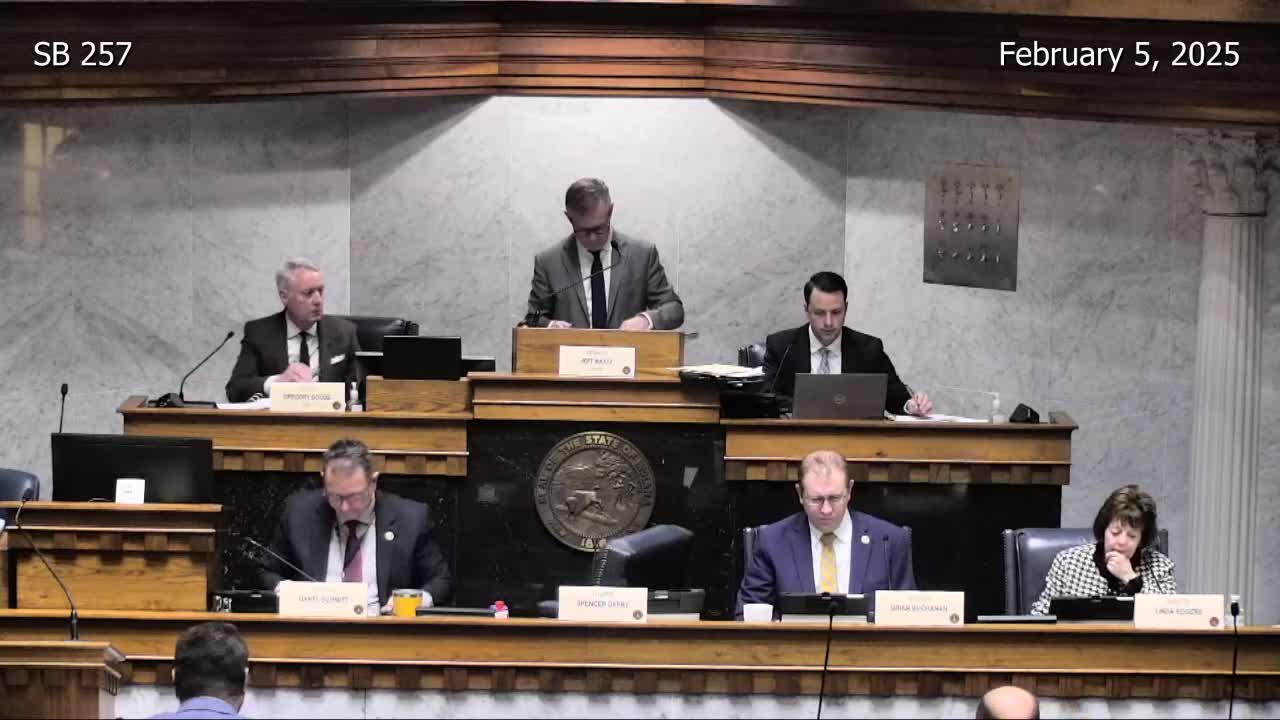
Senate Bill 257, which would set rules for how teachers present founding U.S. documents and forbid instruction that "fosters a national identity" rooted in discrimination or victimization, drew extended testimony Wednesday and was held for one week by the Senate Education and Career Development Committee.
Senate Bill 257, a proposal to direct how K–12 teachers present the Declaration of Independence, the U.S. Constitution and related civic materials, drew extensive debate and public testimony Wednesday in the Indiana Senate Education and Career Development Committee and was held for one week for technical follow-up.
The bill’s sponsor, Senator Michael Geary, told the committee the legislation is intended to ensure civics instruction “fosters an American identity rooted in the aspirational and universal principles of the Declaration of Independence and the U.S. Constitution,” and to guard against what he described as lesson plans that teach students the “malicious men” framework — the idea that the founders deliberately designed government to protect privilege.
Supporters told the committee they want a common civic baseline in schools funded by taxpayers and a process for parents who object to classroom instruction. Cindy Long, assistant executive director of the Indiana Association of School Principals, said Indiana’s academic standards already require rigorous civics instruction and principals follow local procedures when parents raise concerns. “Our educators are dedicated and trained to deliver instruction that is aligned with these standards,” she said.
But critics — including teachers, civil‑liberties advocates, and civil‑rights and urban‑school representatives — said key language in the bill is vague, risks chilling classroom discussion and could expose educators to administrative discipline for covering difficult but state‑required topics. Warren Central High School history teacher Randy Hudgins testified that “No qualified teacher can teach the universal principles of the Declaration of Independence, the Bill of Rights, and the Constitution … without confronting the issues of racial and gender discrimination in our history.” He warned that the bill’s disciplinary language would put educators at risk when answering students’ questions about historical injustice.
Chris Daley of the ACLU of Indiana said the bill’s restrictions could force teachers to “whitewash” American history. “This bill represents terrible education policy and dangerous public policy,” he said, arguing the penalty provisions and the limits on subject matter will be impossible for teachers to reconcile with existing standards and instruction requirements.
Several committee members pressed the sponsor on specifics: how the bill’s list of “universal principles” was selected, how the statute would treat immigrant or non‑citizen students, and whether the measure conflicts with standards developed by the Indiana Civics Education Commission. Senator Geary said the bill narrows how existing statutory mandates should be implemented, not what topics must be taught, and he described the intent as promoting a “flawed but good men” frame for the founders rather than a view that founding documents are inherently oppressive.
Public testimony spanned parents, educators, and policy groups. David Marcotte of the Indiana Urban Schools Association said the language was likely to confuse teachers and parents because “these are realities of the American experience since our founding” and should not be written out of instruction. Multiple witnesses asked the committee to remove or clarify specific prohibitions and to define key terms such as “foster” and “national identity.”
After the testimony, sponsor Senator Geary asked the committee to hold the bill for a week to allow Legislative Services and the sponsor to address technical and drafting concerns. The committee agreed to hold the matter for one week; no formal vote on the bill was taken Wednesday.
The committee chair said the hold is intended to resolve technical issues at the committee level and to give members and stakeholders time to refine language. The matter will return to the committee for further consideration in a week, the chair said.
Details and next steps: The committee accepted public testimony and then paused consideration to allow staff to work on drafting. The sponsor said he remains open to revisions and to further conversation with colleagues and stakeholders.
Article ending: The senator who sponsored the measure described the bill as an attempt to ensure civics instruction supports what he called the “preservation of the free government.” Committee members and public witnesses said they will continue to press for clearer definitions and guardrails before any vote is scheduled.