Get Full Government Meeting Transcripts, Videos, & Alerts Forever!
Get email alerts on the Vehicle Emissions Testing topic
No spam. Unsubscribe anytime.
Indiana Senate committee advances study on exempting drivers 65 and older from vehicle emissions testing in Lake and Porter counties
Summary
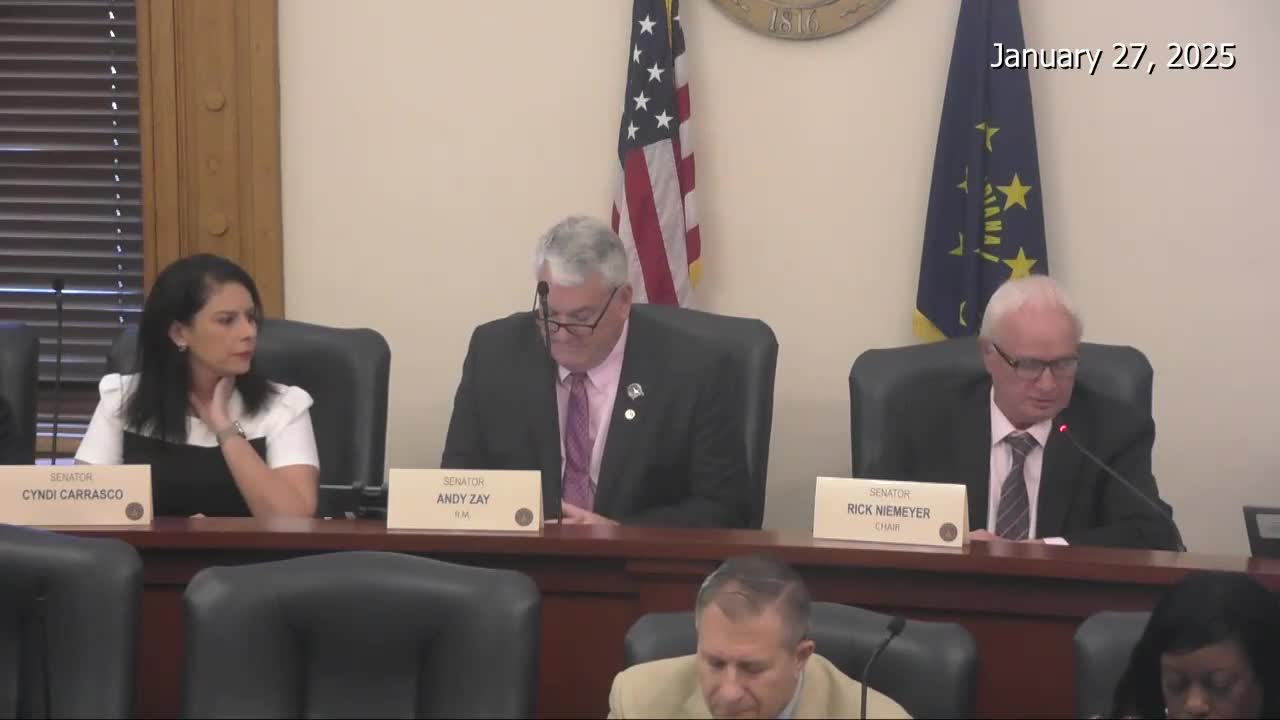
Senate Bill 103, a bill to create a study of whether drivers 65 and older in Lake and Porter counties could be exempted from Indiana’s biennial vehicle emissions testing, was advanced out of the Indiana Senate Environmental Affairs Committee by an 11-0 roll call vote.
Senate Bill 103, a bill to create a study of whether drivers 65 and older in Lake and Porter counties could be exempted from Indiana’s biennial vehicle emissions testing, was advanced out of the Indiana Senate Environmental Affairs Committee by an 11-0 roll call vote.
The bill directs a state study to evaluate whether seniors could be exempted from the automobile emissions program that currently applies to Lake and Porter counties because they are designated nonattainment under the federal Clean Air Act and Indiana’s state implementation plan (SIP). "We're the only two counties left in the state of Indiana that must have that emissions testing done," said Senator Rick Niemeyer, chair of the committee and author of the bill. Niemeyer said the bill would examine options including exemptions and alternatives such as carpooling programs and would quantify the fiscal and administrative impacts.
The measure matters because the testing program traces to Indiana's SIP under the federal Clean Air Act and requires coordination with U.S. EPA Region 5, IDEM and local planning partners. "Indiana's vehicle emissions testing program was instituted as a prescribed requirement of the Clean Air Act," said Drake Abramson, legislative director at the Indiana Department of Environmental Management (IDEM), which testified neutral. Abramson told the committee that any exemption would require a technical demonstration, air modeling and a formal SIP amendment subject to U.S. EPA approval.
Committee discussion focused on the program's origins, what would be involved in changing it and local burden. Niemeyer said the current testing contract costs about "$5.3 million" per year and extends for four years, adding up to roughly "$22,000,000" over the contract term as stated in committee testimony. Several senators noted the burden on older drivers who must travel to one of the county testing sites and sometimes pay repeated repair costs when vehicles fail, including an anecdote of a vehicle repair charge of $195 to reset a battery-related condition after a test failure.
IDEM outlined how a study and any resulting exemption would proceed: identify the number of vehicles and drivers who would be eligible, estimate lost emission reductions, run updated travel-demand and emissions models with support from the Northwest Indiana Metropolitan Planning Organization, and propose offset measures or additional groups to subject to testing. Abramson warned the SIP amendment process can take several years and requires evidence that the change does not reduce the emissions reductions currently in the approved SIP.
Committee members asked for several clarifications that IDEM offered to provide in follow-up: current attainment status (the counties remain in nonattainment though Lake and Porter have improved from a more serious designation), the number of testing sites in Lake County (committee testimony said about three or four), whether exempted categories could be offset by adding other vehicle classes, and the historical use of a repair-assistance hardship program (IDEM said 19 customers used the repair-assistance program in 2023 and that outreach about the program has increased).
Action: The committee moved and seconded the bill; a roll call recorded votes (Jackson: Aye; Nesgotsky: Aye; Taylor: Yes; Zay: Yes; Baldwin: Aye; Bassler: Aye; Buck: Aye; Donnell: Yes; Carrasco: Aye; Bush: Aye; Niemeyer: Aye). The clerk recorded: "Bill passes eleven-zero." The committee’s approval sends SB 103 to the next step in the Senate process.
The bill as passed out of committee is a study directive only; it does not itself change testing or create an exemption. If the study recommends an exemption and the Legislature later adopts one, IDEM said an amendment to Indiana’s SIP and technical demonstrations would be required before any change could be implemented.
Committee members asked IDEM for follow-up materials including the current measured gap to attainment, the number of drivers aged 65 and over who would be affected, and updated counts for the repair-assistance program. The committee chair said the study language could change as the bill moves forward and that he introduced it to start the policy conversation.