
Beaverton School District details bell-to-bell student device rules after governor's order
Get AI-powered insights, summaries, and transcripts
Sign Up Free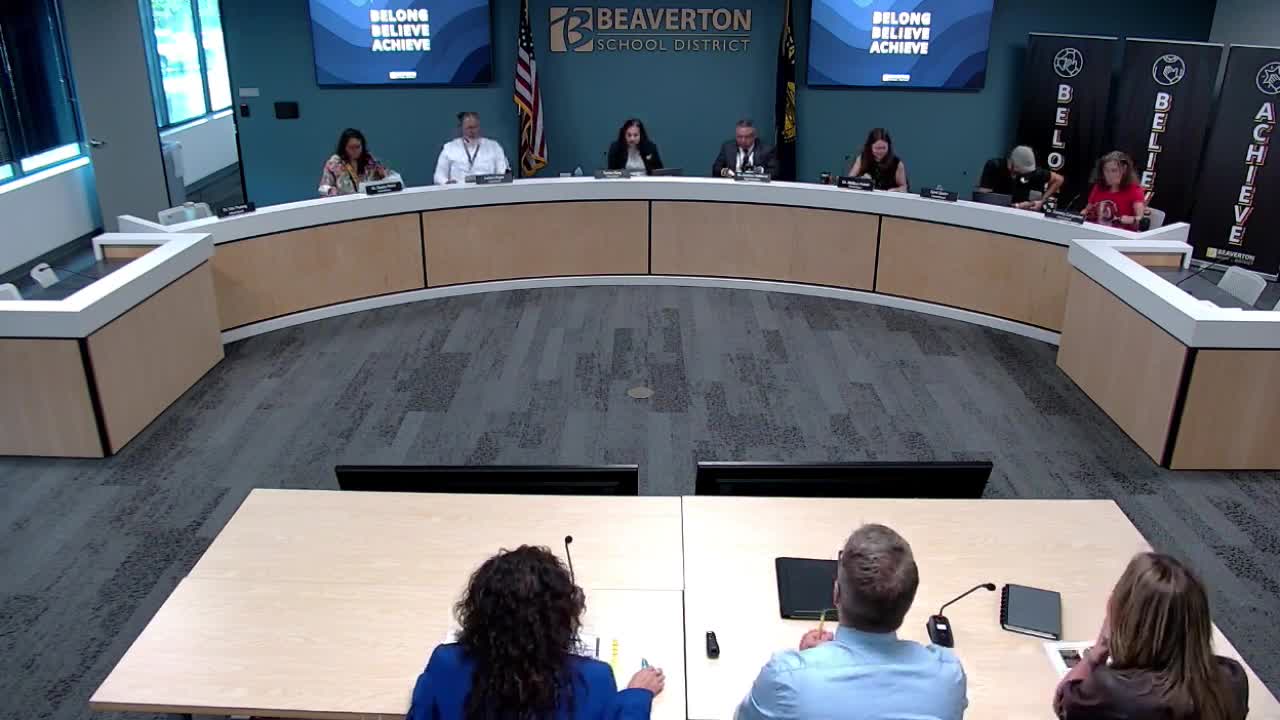
Summary
District leaders told the Beaverton School District 48J Board they have largely implemented a districtwide ban on student personal devices during the school day to comply with the governor's executive order; staff described prior pilots, exceptions for documented needs and plans to track outcomes.
Beaverton School District 48J officials told the school board on Sept. 9 that the district has implemented a bell-to-bell restriction on student personal devices to align with the governor's executive order and that the change so far has required mostly communication and culture-setting rather than new infrastructure.
The update came during a work session when district staff reviewed last year's pilot and community engagement and previewed a forthcoming formal policy amendment required by the governor. "Governor Kotek earlier this summer required all schools to ban K-12 cell phones and personal devices beginning Jan. 1, 2026," said Dr. Shelley Regiani, teaching and learning associate superintendent.
The nut of the district's approach is continuity with the pilot: elementary and middle school practice remained largely the same, and high schools moved from a "pack it or park it" pilot to a bell-to-bell prohibition during the school day. "We piloted last year the idea of pack it or park it, which was very successful," Todd Corsetti, high school executive director, told the board. Under the current practice, students may have devices before school and after school, but devices must be stored during instructional time; documented accommodations such as a 504 plan or an Individualized Education Program (IEP) remain exceptions.
District leaders said the transition was eased because most schools began the groundwork last year: they convened focus groups, ran school-level engagement sessions that included translated outreach where needed, and asked principals to set consistent expectations with staff, students and families. Robin Kabrowski, pre-K–8 executive director, said the district emphasized "student well-being and connection" and that implementation has leaned on relationship-building, not punitive measures.
Board members pressed staff on monitoring and consistency. Director Kassem asked whether the district plans to track exceptions and incidents so the board and community can evaluate how the policy is working over time. Regiani and other staff said the district can report discipline and incident data captured in Synergy and will bring back data as available. Staff described anecdotal declines in in-school online conflicts and fewer fights at some schools since the pilot, but they said formal reporting is limited by what students and staff file.
Board members also raised operational questions: how high schools will supervise thousands of students at lunch and passing time; how parents should contact students in emergencies; and whether equity groups were consulted. Staff said principals are sharing what they learn and that a principal meeting the following day would review early implementation lessons. Regiani noted the equity advisory committee and the district's student advisory helped shape the rollout last year and were used to review cultural impacts and translation needs.
On consistency, staff described a district effort to calibrate responses across buildings. Assistant principals created a behavior-support grid last year to align discipline and responses for technology misuse and other behaviors; the district plans to extend that calibration across middle and high schools. Some operational fixes discussed include using additional support staff to run messages to students during the school day and exploring more efficient in-school message workflows.
Staff emphasized that no new board action was taken at the work session; instead, a separate agenda item will present the recommended policy update that implements the governor's required language. The board did not vote on a policy at this meeting. Staff said they will return with implementation data and suggested metrics at a later date so the board can evaluate whether the policy is meeting its stated goals for student focus, social interaction and safety.
District presenters and board members who spoke during the discussion included Dr. Balderas (staff member), Chair Garg (board chair), Dr. Shelley Regiani (teaching and learning associate superintendent), Todd Corsetti (high school executive director), Robin Kabrowski (pre-K'8 executive director), Director Kassem (board director), Dr. Carpenter (board director), Dr. Parker (board director), Director Perez (board director), Director Raji (board director), Dr. Traum (board director) and Dr. Carpentine (board director).