Get Full Government Meeting Transcripts, Videos, & Alerts Forever!
Get email alerts on the Employee Health Insurance topic
No spam. Unsubscribe anytime.
Greene County absorbs 3% health‑plan premium increase; consultant details claims, telehealth rise
Summary
At a Greene County employee briefing, benefits consultant Mike Scott reviewed the county’s health plan data, saying the county will cover a 3% pool premium increase. Scott presented claims totals, member counts, use of telehealth and other cost drivers, and urged employees to use the UMR app and available cost tools.
At a briefing for Greene County employees, benefits consultant Mike Scott of Barker Phillips Jackson Insurance reviewed the county’s health plan performance and said the county will absorb a 3% increase to the plan’s pool premium for the coming year, keeping employee premiums unchanged.
Scott said the plan’s 12‑month medical claims activity included about $25 million in billed medical claims, roughly $4 million in ineligible or coordination‑of‑benefits charges, and about $20 million in covered medical charges. After plan design and member cost sharing, medical claims paid were reported at about $6.4 million; prescription claims paid were about $2.3 million, for total paid claims of roughly $8.7 million in the period Scott presented.
Why it matters: The county’s decision to pick up the pool increase shifts roughly $266,000 of additional premium cost onto the county budget for the year, Scott said. He and county staff framed that choice as preserving the lower employee cost established after plan changes last year and continuing the county’s higher employer contributions and HSA funding.
Scott gave other plan details he said matter for cost and access: roughly 1,500 plan members (employees and dependents), an average member age of about 34, 99.4% in‑network utilization, 13 catastrophic claimants with costs above $100,000 (one claimant exceeded $500,000), and a notable rise in telehealth use from 283 visits in the prior plan year to 529 visits in the most recent year. Scott also reported an increase in total hospital admission days (361 versus 237 the year before) and a modest rise in emergency‑room visits.
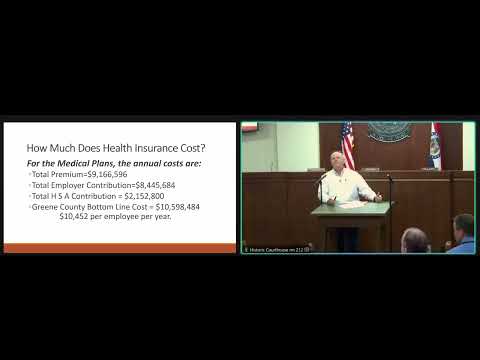
Scott described the plan’s network and discounts as a significant value, saying the UMR arrangement produced an average provider discount of about 60.4% off billed charges. He said the county’s total plan premium for the 12‑month period was about $9.0 million, of which the county paid roughly $8.0 million; he also said the county contributed about $2.1 million into employees’ health savings accounts for HSA participants.
Scott reviewed cost‑management recommendations and user tools: establish and use a primary care physician, favor urgent care or telehealth for lower‑cost care when appropriate, consult the UMR app’s cost estimator and provider directories, and consider pharmacy price comparisons (for example, GoodRx) where appropriate. He also urged employees to call the customer service number on their insurance card, HR, or his office for claim or pharmacy issues; he offered a contact phone number for his firm.
Scott and questioners discussed concerns that can arise when independent physician groups (for example, emergency physicians, anesthesiologists or radiology groups) bill separately from a hospital’s facility charge. Scott said being treated at an in‑network facility generally secures in‑network benefits even if a particular professional group is independently contracted, but he advised employees to call for help if they receive an out‑of‑network bill.
On broader trends, Scott cited national data showing that premiums and employer contributions have increased faster than general inflation since 2014 and projected health‑care trend estimates of about 8.5% next year and pharmacy trend around 12.5%. He warned that the county may not be able to absorb future increases every year and that premium or benefit changes could be required in the future.
The presentation closed with Scott encouraging employees to use wellness programs sponsored through the Midwest public risk consortium, download the UMR app, and contact his office or HR for billing or claim disputes. He said UMR and the consortium (Midwest Public Risk) handle claims processing and negotiations, and that many billing problems are resolved through those channels.
Contact: Scott provided a phone number for Barker Phillips Jackson Insurance during the briefing for follow‑up questions.