Get Full Government Meeting Transcripts, Videos, & Alerts Forever!
Get email alerts on the Budget And Charter Election topic
No spam. Unsubscribe anytime.
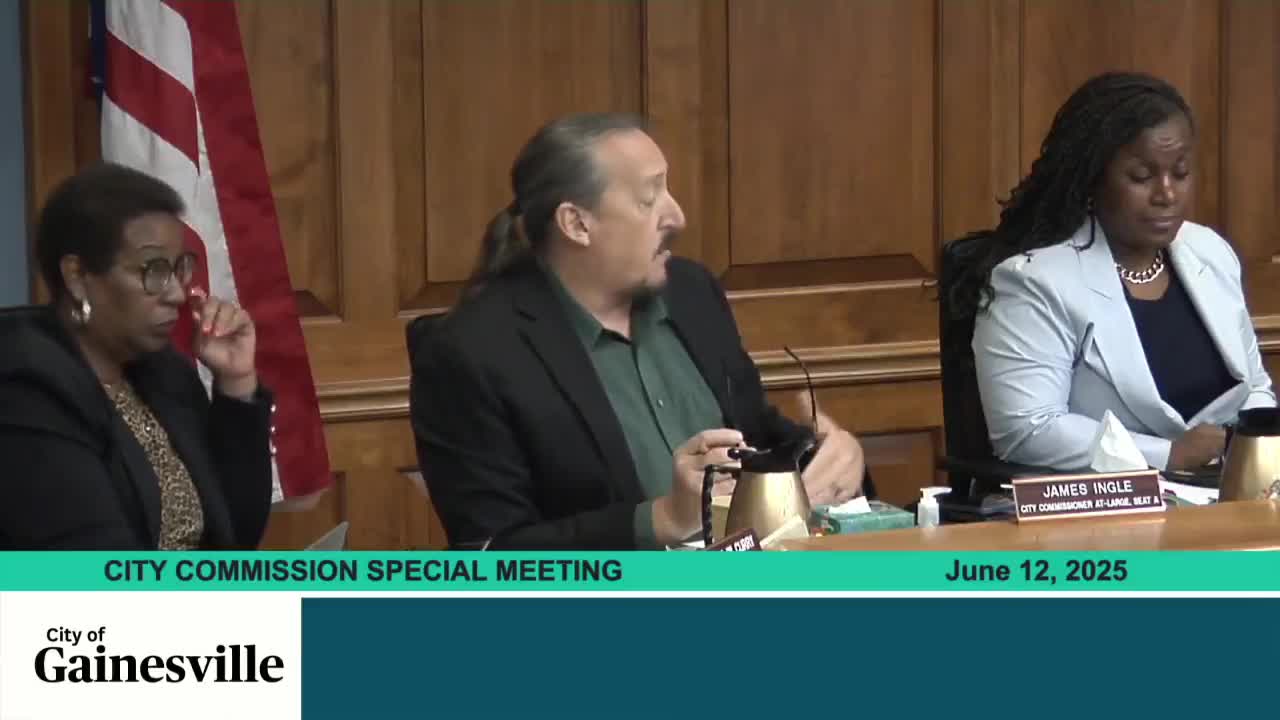
Commission advances charter amendment to put GRU governance question on November ballot; budget gap prompts planning choices for transit and city services
Summary
The City Commission voted to place a proposed charter amendment on the Nov. 4 special election ballot on GRU governance and received a budget update showing a FY2026 general‑fund gap driven mainly by reductions to the GRU government services contribution and rising transit and pension costs; commissioners directed staff to pursue the staff‑recommended mixed approach and return July 17 with detailed funding and budget analyses.
What the commission decided about the GRU charter question
On June 12 the Gainesville City Commission voted to place a proposed amendment to the City Charter (Article 7) on the ballot at a special election Nov. 4, 2025. The ordinance to submit the charter amendment was adopted on second reading, and the commission then approved a companion resolution calling the special election and directing staff to begin canvassing‑board preparations. City attorneys flagged a minor punctuation edit to the charter language; otherwise the ordinance forwarded a clean proposed ballot question for voter consideration. The Commission also asked the clerk to advertise for citizens to serve on the canvassing board for that special election.
Why the ballot question matters: The proposed charter amendment pertains to governance of Gainesville Regional Utilities (GRU). The vote follows more than two years of public debate and litigation concerning GRU’s status and the size of the annual government services contribution that GRU transfers to the city.
Budget development update and a structural gap
City staff (Finance and the City Manager’s Office) presented a fiscal year 2026 general‑fund baseline that shows an estimated revenue shortfall driven primarily by reduced transfers from GRU’s government services contribution, higher pension and insurance costs, and transit revenue pressures. Staff reported the June 1 taxable value estimate was up about 6.3% year‑over‑year and built that into revenue projections, but also said state revenue sharing and the final property figures were still pending.
Staff presented four gap‑closing scenarios to the commission: (1) close the gap with a millage increase only, (2) a half‑mill increase plus use of excess fund balance, (3) staff’s recommendation — a mix of reductions, a 0.5‑mill increase and limited use of excess fund balance (preferred), and (4) no millage increase with larger budget reductions and a larger draw on fund balance. The staff‑recommended scenario (scenario 3) included a 0.5‑mill increase, limited reductions (including a 50% reduction to fleet fixed payments and a partial reduction in requested police/fire overtime), and a modest use of excess fund balance; staff noted a remaining contingency would still be preserved. After discussion the commission directed staff to return with the scenario 3 approach ready for the next budget step and asked staff to produce several analyses: the fiscal impact of salary freezes for the top 25%, 15% and 10% of non‑bargaining employees (including potential fringe or pension impacts), and an analysis of continuing to freeze some previously frozen police positions and the operational impacts of leaving other vacancies unfilled.
Transit (RTS) and paratransit (ADA) discussion
A central budget pressure is rising RTS operating costs, in large part because of a drop in revenue from the University of Florida contract and federal grant changes; staff estimated an RTS budget hole in the range of several million dollars (staff cited figures that led to recommendations for significant service reductions unless new revenues or efficiencies are found). Transportation director Jesus Gomez described planned service reductions and cost‑savings options, including leasing some off‑service buses and increasing shelter/bench advertising revenue. In parallel, the commission heard a public debate about bringing ADA/paratransit service in‑house; MV Transportation (current contractor) cautioned the city that insourcing could be more costly and make MV’s remaining service unviable. Several disability advocates and regular paratransit riders urged the commission to preserve service stability and continuity.
Next steps and follow‑ups
- The Commission approved placing the GRU charter amendment on the Nov. 4, 2025 ballot and approved a resolution calling the special election and directing the clerks to begin canvassing‑board preparations. - For the FY2026 budget the commission directed staff to return July 17 with further detail on scenario 3 and to provide the requested analyses on salary freeze impacts and vacancy impacts (including targeted studies on police positions and selected administrative vacancies) to support final decisions before the millage and budget settings.
Ending: Commissioners emphasized the importance of returning to voters for major governance questions, asked staff for more precise budget numbers and additional options (including potential bonding and GCRA strategies), and underscored interest in minimizing service disruptions to residents reliant on transit and paratransit services.