Get Full Government Meeting Transcripts, Videos, & Alerts Forever!
Get email alerts on the Infrastructure topic
No spam. Unsubscribe anytime.
Consultants propose sewer feasibility studies at three Gadsden County sites to spur development
Summary
WSB Engineering presented a proposal to Gadsden County commissioners to study sewer service feasibility at three targeted sites—Midway near I‑10, 52 county acres off Joe Adams Road, and parcels near Havana—arguing studies are needed to attract developers, support grant applications and clarify costs and timelines.
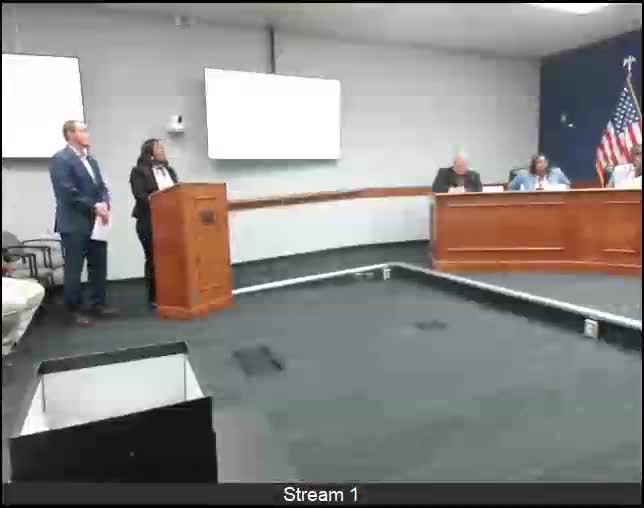
WSB Engineering told the Gadsden County Board of County Commissioners that sewer feasibility studies at three targeted sites would be a necessary first step to support economic development and future grant applications.
Chandra Gaines, a WSB project manager, and Drew Pail, senior director of municipal services at WSB, outlined a phased scope that would examine generation (how much wastewater proposed development would create), conveyance (gravity versus pumping) and disposal (capacity and expansion of treatment plants). The firm said the studies would also identify permitting, routing and environmental constraints, and produce GIS maps and final reports that county staff and economic development recruiters could use with prospective developers.
WSB identified three priority locations: parcels near the Midway I‑10 Exit 192 area (noted as having the highest developer interest and strategic interstate access), 52 county‑owned acres off Joe Adams Road (described as close to commercial anchors and municipal boundaries) and parcels near Havana toward the Georgia line (a longer‑term site tied to commuter growth toward Bainbridge, Ga.). The firm said the Quincy area wastewater treatment plant has roughly 1,500,000 gallons per day capacity and the Havana plant about 150,000 gallons per day, details WSB identified as relevant to disposal alternatives and potential upgrades.
WSB gave rough cost and timing estimates. Feasibility work for one site was estimated at about $50,000; WSB said there would be economies of scale for multiple sites and suggested additional sites could be studied for about $35,000 each, putting a three‑site package at roughly $120,000. The consultants estimated 3–4 months for a feasibility study, another 3–4 months for design and bid documents, and 6–9 months for construction depending on complexity. Construction cost guidance included a broad range for gravity sewer of roughly $1,750–$2,200 per linear foot (about $1 million per mile as a thumbnail) and lift station costs in the low hundreds of thousands; WSB emphasized exact numbers would come from the studies.
Commissioners and staff raised site‑specific concerns during the presentation, including the distance from Midway sites to existing treatment plants (10 miles was cited as an example), barriers such as rivers and interstate crossings, and whether service could be provided by gravity or would require pumping and lift stations. Several commissioners emphasized the need to coordinate with partner cities (including Quincy) and to explore grant funding sources before committing to design or construction.
No formal county action was taken at the meeting; WSB presented the studies as a proposal and county staff indicated the item could return on a later agenda if the board wished to authorize the work.
Ending: If commissioners choose to proceed, the feasibility reports WSB described would be used to support grant applications and to show potential developers that the county is “development ready.” WSB and county staff said the studies would produce cost estimates and maps intended to make applications more competitive and reduce unknowns for private investors.