Get Full Government Meeting Transcripts, Videos, & Alerts Forever!
Get email alerts on the Digital Assets Clarity Act topic
No spam. Unsubscribe anytime.
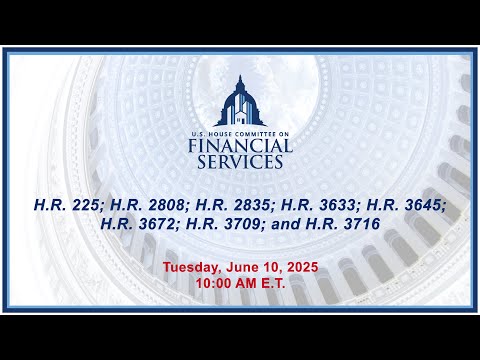
House Financial Services markup advances 'Clarity Act' debate over digital-asset rules
Summary
The House Financial Services Committee debated the Clarity Act, a bill that would divide digital-asset responsibilities between the Securities and Exchange Commission and the Commodity Futures Trading Commission and set new rules for exchanges, custody and offerings.
The House Financial Services Committee spent its longest contiguous debate on the Clarity Act, a sweeping market-structure bill that would draw lines between the Securities and Exchange Commission and the Commodity Futures Trading Commission for the regulation of digital assets and related intermediaries.
Committee Chairman French Hill (R-Ark.) opened the discussion by urging lawmakers to act. "Today and moving forward, we have the opportunity to bring long desired and much needed clarity to the digital asset market," he said, describing the measure as a framework to protect consumers, encourage innovation and assign agency roles.
Supporters and the bill’s drafters argued the legislation fills a long-standing void. Subcommittee Chairman Bridil Stahl (Wis.) said the lack of consistent rules has pushed innovation offshore and left investors exposed. "The Clarity Act provides straightforward answers to key questions," he said, listing jurisdictional allocation, listing standards and protections for customer custody among the bill’s objectives.
Opponents, led by Ranking Member Maxine Waters (D-Calif.), raised sharply different concerns. Waters said the bill could expose investors to fraud and create national-security risks, and complained it did not address alleged conflicts of interest involving the sitting president. "This bill creates vague new definitions that will result in endless litigation," Waters said, adding that Democrats would press amendments to halt perceived avenues for corruption.
Lawmakers debated several technical and policy points during the markup: - Jurisdictional lines: Sponsors said the measure draws a functional distinction between what will be treated as a security (SEC jurisdiction) and what will be treated as a digital commodity (CFTC jurisdiction), and establishes registration and disclosure obligations tied to those definitions. - Exchange rules and listing standards: The bill sets new listing and transparency requirements for venues that list digital assets, including obligations intended to reduce fraud and protect customer funds. - Mature-blockchain certification: The draft includes a statutory mechanism for an issuer to seek recognition that a blockchain system is "mature," which would affect how tokens tied to that system are treated. Several members asked whether the SEC will have the staff and the authority to review self-certifications within the bill’s 60-day window. - Anti-fraud and AML: Sponsors emphasized that broker-dealer equivalents and custodial intermediaries would remain subject to anti-fraud and Bank Secrecy Act obligations. Several members pressed for clearer mechanisms to prevent illicit finance, and one amendment under consideration would have directed a Treasury-led study of identity technologies to aid compliance. - Conflicts of interest: Multiple members urged stronger prohibitions on elected officials or government decision-makers from issuing or holding digital assets that could benefit from regulatory or procurement decisions. The committee discussed, but did not adopt, proposed language that would bar federal elected officials from issuing digital assets tied to regulatory outcomes.
Quotes from the hearing captured the partisan divide. Chairman Hill framed the bill as a tool to protect consumers and keep innovation in the United States. "This legislation is a critical step towards providing legal certainty, protecting consumers, and ensuring that The United States remains a leader in digital innovation," he said. Subcommittee Chair Stahl stressed the bipartisan effort to complete a market-structure framework. "By answering the questions, you'll also see it provides market participants the confidence to build and invest," he said.
Waters and other Democrats urged stronger guardrails. She described the bill as "a rushed, complicated, unnecessary legislation" and said Democrats would press amendments aimed at preventing conflicts of interest and addressing investor protection gaps not solved by the bill’s text.
Several technical amendments were offered during the markup. Committee staff said in-committee deliberations and follow-up rulemakings could adjust details such as certification procedures, disclosure timing and the precise compliance obligations for custodians and intermediaries. Members repeatedly asked for additional agency technical assistance to estimate staffing and systems changes needed to implement the statutory tests for maturity and for other determinations the bill delegates to regulators.
At the close of the first day’s consideration, the committee did not resolve all outstanding amendments. Multiple recorded votes were requested and postponed; members signaled they would return to several contested provisions in subsequent sessions.
Why it matters: The Clarity Act would be among the most consequential changes to U.S. financial markets in years if enacted. The bill’s outcome will affect where digital-asset firms choose to locate, how exchanges and custodians operate, what protections investors receive, and how law enforcement and regulators coordinate against fraud, manipulation and illicit finance. Advocates say clear rules will bring jobs and capital to the U.S.; opponents say the bill, as written, risks creating regulatory loopholes and conflicts of interest.
Next steps: Committee leaders said further markup sessions and technical revisions are likely. Multiple members asked for more complete written technical advice and resource estimates from the SEC and CFTC and indicated they would continue working with regulators and staff to refine the bill before final committee votes and any floor action.