Get Full Government Meeting Transcripts, Videos, & Alerts Forever!
Get email alerts on the Parking Policy topic
No spam. Unsubscribe anytime.
Committee hears widespread support to remove parking minimums in CMX‑4 and CMX‑5
Summary
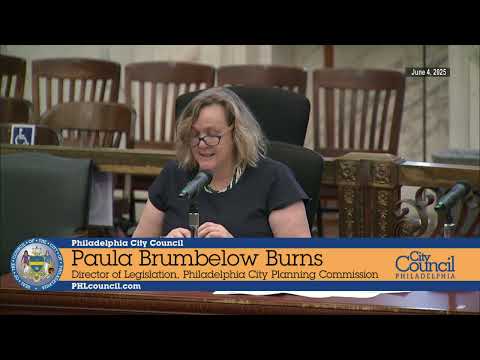
At a June 5 public hearing, the Philadelphia City Planning Commission and more than a dozen witnesses urged the Rules Committee to approve legislation eliminating minimum residential parking requirements in CMX‑4 and CMX‑5 zoning districts, saying removal would lower housing costs and enable more units near transit.
The Committee on Rules of the Philadelphia City Council heard extensive testimony June 5 supporting bill 250524, which would remove residential parking minimums for multifamily housing in CMX‑4 and CMX‑5 zoning districts. Advocates, planning staff and developers told the panel that the change would lower construction costs and enable more housing near transit.
Supporters said the change is aimed at Center City and University City, where transit access and walkability reduce demand for mandatory parking. "Removing parking minimums in Philadelphia's most dense neighborhoods will make it easier and less expensive to build housing," said Diana Lind, founder of New Urban Order, during public comment. Michael Gough, senior legislative planner with the Philadelphia City Planning Commission, told the committee the removal of the requirement "could have enabled 337 additional units of residential and multifamily housing" in Greater Center City in 2024.
The Philadelphia City Planning Commission presented analysis showing CMX‑4 and CMX‑5 are concentrated in the most transit‑rich parts of the city and that eliminating the current minimum of three parking spaces per 10 units in those districts could reduce the per‑unit cost of construction. "Minimum parking requirements increase the cost of housing, reduce housing production, encourage more driving, and reduce property values," said Eric Guerra, associate professor of city and regional planning at the University of Pennsylvania.
Witnesses from advocacy and industry agreed on many points. Tatania Markland of the Clean Air Council said removing the mandate "will provide a cost saving opportunity for housing, reduce car dependency, and help to create a more walkable and cleaner and greener city." Carrie Rathman of Habitat for Humanity Philadelphia said parking requirements have previously derailed projects and called the change "much needed" for lowering development costs. The Building Industry Association also voiced support and suggested expanding reforms to CMX‑3.
Several speakers recommended additional safeguards. AARP Pennsylvania, represented by Nora Dowd Eisenhower, urged that the committee balance deregulation with protections: in particular, dedicated accessible parking and properly sited pick‑up/drop‑off zones for people with mobility needs. Council members pressed planning staff about whether any CMX‑4 or CMX‑5 parcels outside Center City would be affected; staff said two such parcels were identified and that changes had been coordinated with the affected district offices.
Speakers representing Old City's business district described local experience after a prior elimination of parking mandates in that area and said they saw increased foot traffic, new housing conversions and no complaints from businesses. "Four years after the elimination of parking mandates in the commercial core of Old City, we have not received a single complaint about their elimination," said Joe Bitzkowitz, executive director of the Old City Special Services District.
No vote was taken on bill 250524 at the hearing. The Planning Commission will take up the bill at an upcoming public meeting and committee members said they expect further conversations about mapping and exemptions for outlying parcels.
The panel also heard public comment urging consideration of extending similar parking reforms to CMX‑3 and other transit corridors.