Get Full Government Meeting Transcripts, Videos, & Alerts Forever!
Get email alerts on the Charter Revision topic
No spam. Unsubscribe anytime.
North Lauderdale panel begins charter modernization; debates term limits, residency checks and vice mayor rotation
Summary
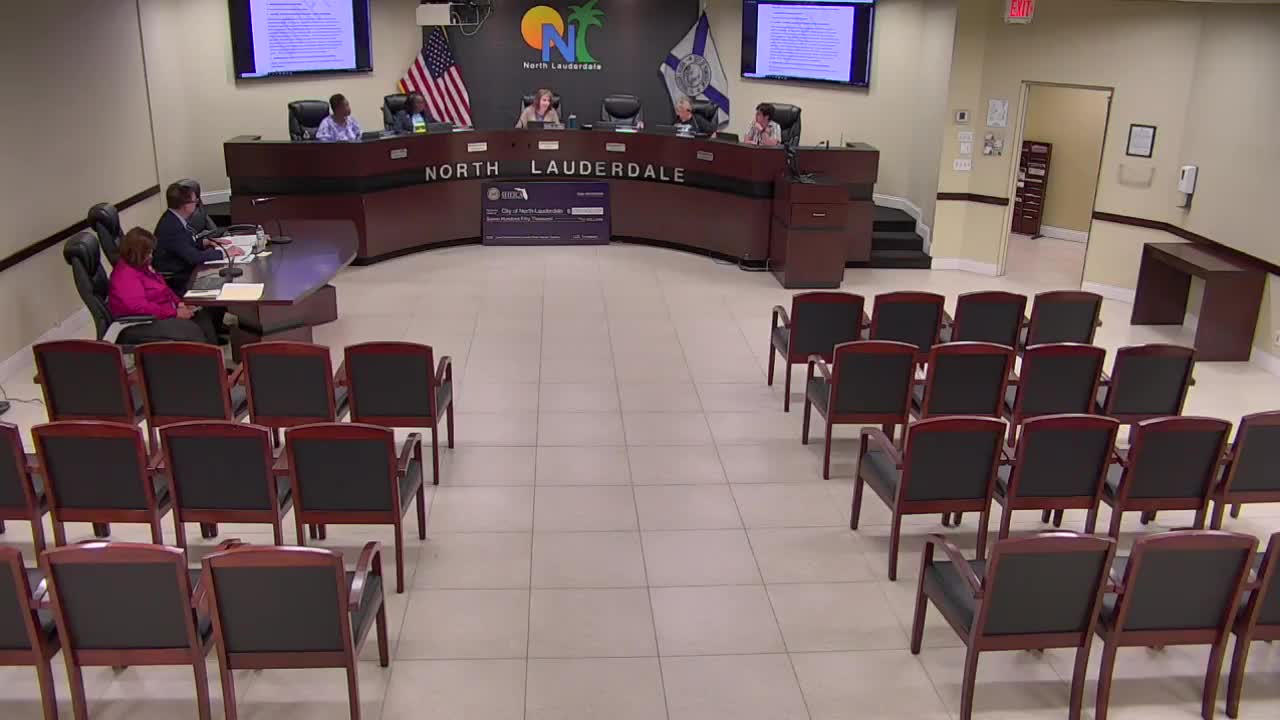
City of North Lauderdale commissioners and staff spent a meeting‑length session reviewing proposed updates to the municipality's charter, discussing modernizing language and procedural clarifications and asking the city attorney to draft specific amendment text for voters.
City of North Lauderdale commissioners and staff spent a meeting-length session reviewing proposed updates to the municipality's charter, discussing modernizing language and procedural clarifications and asking the city attorney to draft specific amendment text for voters.
At a roughly two-and-a-half-hour session focused on Parts 1–3 of the charter, City Attorney Wolfen outlined the document's general powers language and several fixed limits – including the existing provision that franchise grants may not exceed 30 years. Wolfen said the charter's grant of municipal authority mirrors the state home‑rule framework, noting it should be read "most favorably to the city." He also recommended leaving many operational specifics (for example, franchise rates and customer-service rules) to the city code and individual franchise ordinances.
The meeting’s largest policy debates centered on election qualifications and governance mechanics. Commissioners discussed whether the minimum age to qualify to run for office should remain 18 — the current standard cited in the charter — or be raised to 21, a suggestion raised by a district representative. Commissioners speaking in favor of keeping 18 noted that the city's teen advisory board and civic engagement among younger residents argue for inclusion; others said 21 would reduce the likelihood of very young, inexperienced candidates.
Attendees also reviewed how commissioners are elected: the charter establishes a mayor elected at large and four commissioners elected from single-member districts with a one‑year domicile requirement prior to qualifying. Commissioners and the attorney flagged inconsistent phrasing in sections that describe district voting and said those passages should be clarified; Wolfen pointed to a newer section that already clarifies single‑member district voting but agreed it could be moved earlier in the text for clarity.
Term limits produced extended discussion. Several commissioners said two elected terms (eight years) would be too short to allow elected officials to advance multi‑year projects and recommended three consecutive terms instead. By consensus the group directed City Attorney Wolfen to draft proposed charter language for a term‑limit amendment (the attorney said he would prepare wording for a three‑term limit with options for a break‑in‑service clause). That draft will be returned to the panel for further editing before any proposal is placed on a ballot.
Redistricting procedure and verification of residency also drew sustained attention. The charter requires periodic redistricting after each decennial census and specifies that an expert from an accredited four‑year institution prepare the maps and legal descriptions. Commissioners asked for clearer language about public participation and adoption by ordinance; Wolfen confirmed such adoption would be by ordinance and that public comment opportunities would normally be afforded during the expert presentations.
Separately, several panel members pressed for stronger residency verification for sitting commissioners. The charter requires candidates to be domiciled in their district for one year prior to qualifying, but the clerk explained that qualifying paperwork now typically relies on ID and an oath rather than multiple documentary proofs. Commissioners asked staff to draft a recommendation that seated commissioners file an annual attestation confirming continued residency in their election district; the request was recorded as a consensus recommendation to the clerk and attorney to prepare implementation language.
The group discussed vacancy and forfeiture rules in section 3.6. The charter currently provides that a commissioner forfeits office if they lose the required qualifications, are convicted of certain crimes, or fail to attend four consecutive regular meetings without an excused absence. Commissioners raised concerns that the phrase "excused by formal action entered upon the minutes" leaves too much discretion and can be applied inconsistently. Wolfen noted an existing municipal ordinance governs excused absences and that removal for nonattendance is a serious step that typically involves a factual investigation or commission action.
On governance procedures, commissioners debated how the vice mayor should be chosen. The charter presently directs the commission to elect a vice mayor annually at the last November meeting. Some members favored retaining the internal election by majority vote; others proposed a rotation by district so that each district's commissioner serves as vice mayor in turn. Wolfen suggested draft language that would prescribe rotation but allow an individual to decline; the commission accepted that compromise as a potential ballot amendment to be drafted for review.
Legal and ethics provisions drew brief attention. The charter bars elected officials from city employment or compensated appointive office for one year after their term ends. Commissioners asked that the text make clear this restriction applies only to compensated positions and does not bar service on volunteer advisory boards; Wolfen agreed to prepare clarifying language.
Formal action taken at the meeting was limited. The commission approved the minutes from the prior meeting by roll call at the start of the session. Later, by consensus the panel asked the city attorney to draft proposed language for term limits and asked staff to prepare recommended language for annual residency attestations and for clarifying the compensated‑position ban.
What happens next: Attorney Wolfen will draft the proposed term‑limit amendment and redraft suggested clarifications (including residency verification language and the compensated‑position clarification). The committee will reconvene to continue the line‑by‑line review beginning at section 3.6 and will consider the attorney’s draft language before any measure is placed on a ballot or formally referred to the commission for action.
Votes at a glance
- Approval of minutes: Motion made and seconded; roll call recorded as affirmative by Board Members Armstrong, Gallata, Shane, Johnson and Chair Engold (motion approved).
(End)