Get Full Government Meeting Transcripts, Videos, & Alerts Forever!
Get email alerts on the Encampment Management topic
No spam. Unsubscribe anytime.
City realigns street response under emergency management, outlines hot‑spot and closure maintenance strategy
Summary
The city’s Emergency Management and Crisis Response department will centralize field operations for encampments, using hot‑spot interventions, closure maintenance and coordinated outreach in partnership with Housing Forward; officials set performance targets and noted a 45% increase in related 3‑1‑1 requests since 2021.
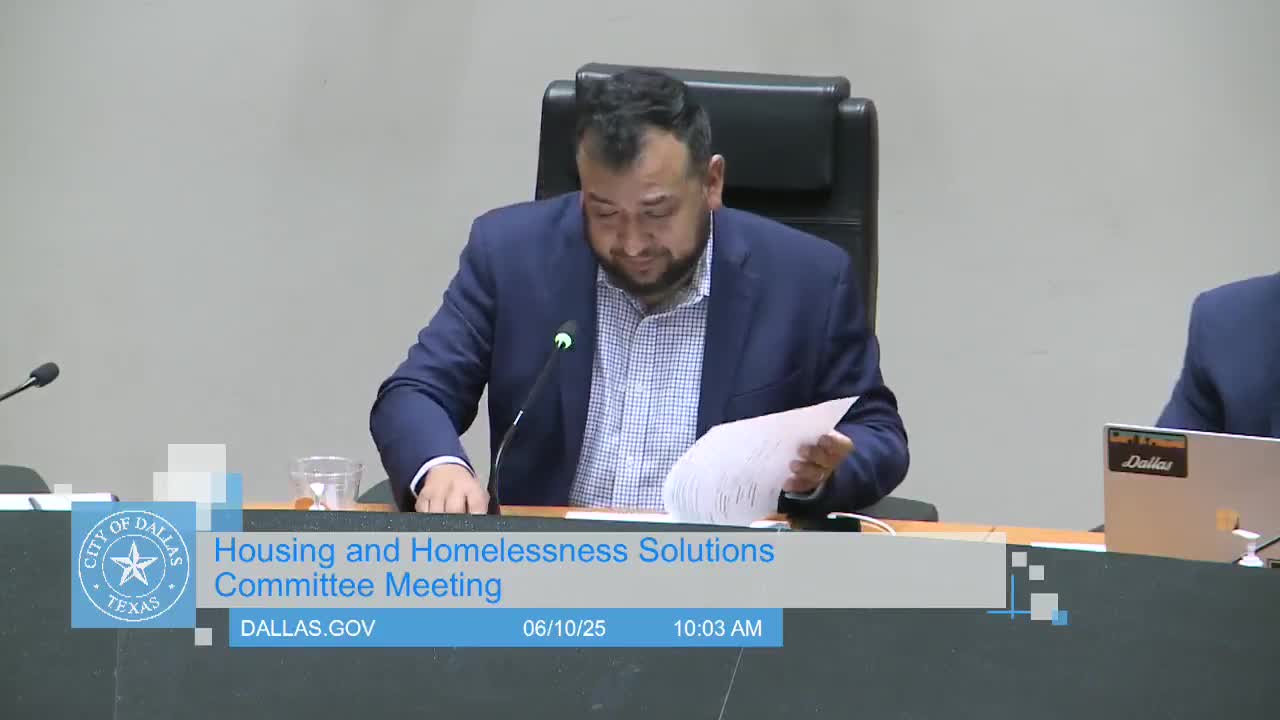
The City of Dallas has moved operational responsibility for field response to encampments into the Office of Emergency Management and Crisis Response and laid out a three‑pronged strategy — hot‑spot interventions, sustained closure maintenance and integrated behavioral‑health support — committee members were told June 10.
“We have a clear and direct mission,” Kevin Oden, director of Emergency Management and Crisis Response, told the Housing and Homeless Solutions Committee. The presentation described a realignment that centralizes field deployment, service‑request triage and encampment closure under Oden’s department while leaving long‑term policy, contracts and system planning with the Office of Homeless Solutions.
Oden said the change includes staffing and budget for a 23‑person field team and outlined how every encampment‑related 3‑1‑1 service request will be triaged into engagement/outreach, hot‑spot short‑term intensive responses, or closure maintenance. The department reported a rise from roughly 8,000 encampment service requests in 2021 to more than 11,000 last year — a roughly 45% increase — and said it is redesigning 3‑1‑1 workflows to prioritize immediate hazards and high‑risk sites.
Hot‑spot operations are defined as short, intensive, multi‑department responses to areas with repeated re‑encampment, elevated crime or significant public nuisance; closure maintenance is regular patrols and offers of day‑shelter access to keep cleared sites from reoccupying. Oden described a downtown closure effort that relies on persistent presence and coordination with Housing Forward’s outreach teams so people are offered shelter and housing pathways rather than simply moved from block to block.
Oden offered performance targets the department will publish: respond to 90% of high‑priority 3‑1‑1 requests within 24 hours and keep 80% of hot‑spot sites clear for 30 days. He said the Dallas Street Response program will track offers made, response times and re‑encampment rates and provide quarterly accountability reports to the council.
The committee’s discussion focused on operational details and equity across council districts. Several members said they regularly see encampments and drug‑related public safety concerns in non‑downtown districts and sought assurance the strategy would be applied citywide. Oden said the department is building an objective mapping process to identify hot spots and will coordinate with TxDOT, the transportation department, public works and police to schedule cleanups and, when needed, lane closures for safe operations.
Oden emphasized that enforcement will be a last resort, executed by law enforcement officers according to training and constitutional protections; he said the city will coordinate with municipal and community courts when citations lead to court referrals, and that partners such as the district attorney and behavioral‑health authorities have been engaged for complex‑needs cases.
The committee voted to place the realignment on the full council agenda for approval; Oden said the operational team is already in the field and that the city will begin publishing dashboards and weekly outcomes this quarter.