Lifetime Citizen Portal Access — AI Briefings, Alerts & Unlimited Follows
Council hearing: District officials outline plan to create Basic Health Plan for low‑income residents
Loading...
Summary
At a June 9 Committee on Health hearing, the DC Health Benefit Exchange and the Department of Healthcare Finance described steps to create a Basic Health Plan (BHP) to cover low‑income residents moving off Medicaid, and said they expect federal funding to determine final benefits and cost sharing.
Chair Christina Henderson opened the Committee on Health hearing on June 9, saying the session would focus on the Health Benefit Exchange, the Department of Healthcare Finance and the Office of the Deputy Mayor for Health and Human Services.
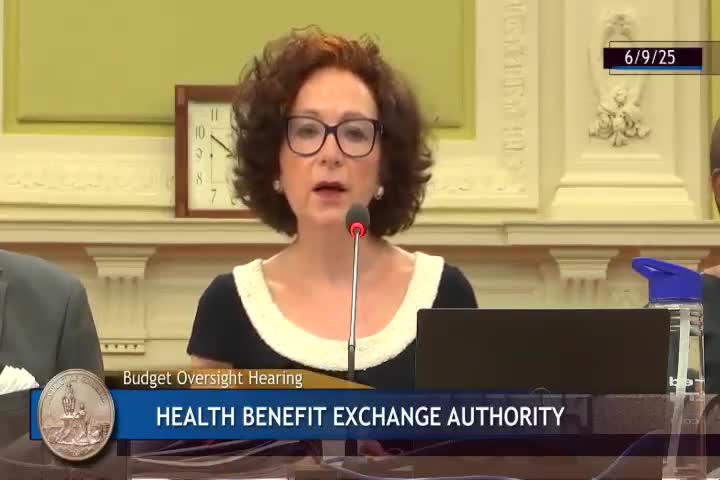
Mila Kauffman, director of the DC Health Benefit Exchange Authority (HBX), told the committee that HBX and its federal partners plan to implement a Basic Health Plan (BHP) under the Affordable Care Act to cover lower‑income residents who would otherwise buy commercial coverage through DC Health Link. "Our goal is continuity of coverage and continuity of care for residents," Kauffman said.
Kauffman said the federal option under ACA Section 1331 allows states to design a BHP that can be financed largely with federal funds: federal rules provide 95% of the value of premium tax credits for the eligible population but do not fund state administrative and operational costs. HBX has convened advisory councils and working groups — carrier, IT and operations — and hired actuaries to model benefit designs and costs.
Why it matters: city leaders presented the BHP as a way to avoid shifting substantial out‑of‑pocket costs to residents who would lose Medicaid eligibility under the mayor's budget proposals. Kauffman said actuarial modeling showed a BHP designed with the ACA commercial benefit structure could offer no premiums and no cost sharing for medical care for the target population — though she stressed that final benefit details will depend on the federal funding available and on federal approval of the city's blueprint.
Key provisions and constraints
- Eligibility: Kauffman described the proposed population as residents not eligible for Medicaid but with incomes from just above Medicaid thresholds up to about 200% of the federal poverty level. Lawfully present residents who are barred from Medicaid by the federal five‑year rule (sometimes called the "5‑year bar") would be eligible; undocumented residents would not, she said. Pregnant people who qualify for Medicaid would continue to receive coverage through Medicaid, because federal rules prohibit BHP payments for pregnant people who are Medicaid‑eligible.
- Benefits: Kauffman said a BHP based on the ACA commercial benefit design would cover hospitalization, primary and specialty care, lab work and most behavioral health services, but would not include certain Medicaid benefits. She noted adult dental, adult vision and non‑emergency transportation typically are not included under the ACA commercial benefit design. "Behavioral health is covered differently than under Medicaid," she said.
- Networks and continuity: HBX invited all managed care organizations (Amerigroup, AmeriHealth, MedStar Family Choice) and major insurers (CareFirst BlueCross BlueShield, Kaiser Permanente) to participate so enrollees could remain with their existing MCO when feasible. Kauffman emphasized the goal of minimizing disruption: "If MCOs that currently cover DC's Medicaid population choose to participate in the BHP, then enrollees will be able to stay with the same MCO as they have now." She said the Exchange is testing data transfers to allow automatic account creation for affected enrollees.
- Cost modeling: Kauffman and HBX said actuarial work assumes enhanced premium tax credits are not extended — a conservative assumption — and still found a path to a BHP with no premiums and no medical cost sharing using an ACA benefit structure. She said adopting Medicaid‑style benefits (capitated Medicaid rates and hospital payments) would require an estimated near $60,000,000 in additional local funding.
Timeline and federal approvals
HBX officials said they plan to have IT and operational work completed by October 1 to allow open enrollment processes to proceed, with the staff‑level BHP blueprint to be posted for 30 days of public comment and then submitted to the federal Centers for Medicare & Medicaid Services (CMS) for approval. Kauffman said HBX has begun early federal engagement and expected weekly working‑group meetings through the summer to finalize the blueprint.
Limits and uncertainties
Both HBX and committee members repeatedly emphasized that the federal funding decision and federal approvals will determine whether the BHP can include adult dental, vision or other enhancements. Kauffman said: "The amount of federal dollars will determine what the BHP can do for residents." Committee members expressed concern about potential coverage gaps and differences between Medicaid and BHP commercial benefits, particularly for long‑term care, non‑emergency transportation and dental.
What to watch next: HBX will post a draft blueprint for public comment and continue weekly technical working groups with carriers and IT vendors. The committee requested follow‑up on behavioral health differences between Medicaid and a BHP, and on how pregnancy and postpartum coverage would be handled during transitions.
Speakers quoted in this report are identified in the meeting record and were sworn for testimony.