Get email alerts on the Rural Living Hamlets topic
No spam. Unsubscribe anytime.
Board discusses hamlets, 1–5 acre 'mini farm' demand and infrastructure constraints
Summary
Commissioners and planning staff reviewed existing hamlet options in the land-use code (1 unit per 5 acres or 1 per 3.5 acres with a water system), noted constraints in farmland preservation areas, and discussed how water, septic and fire-flow requirements affect small-holding development.
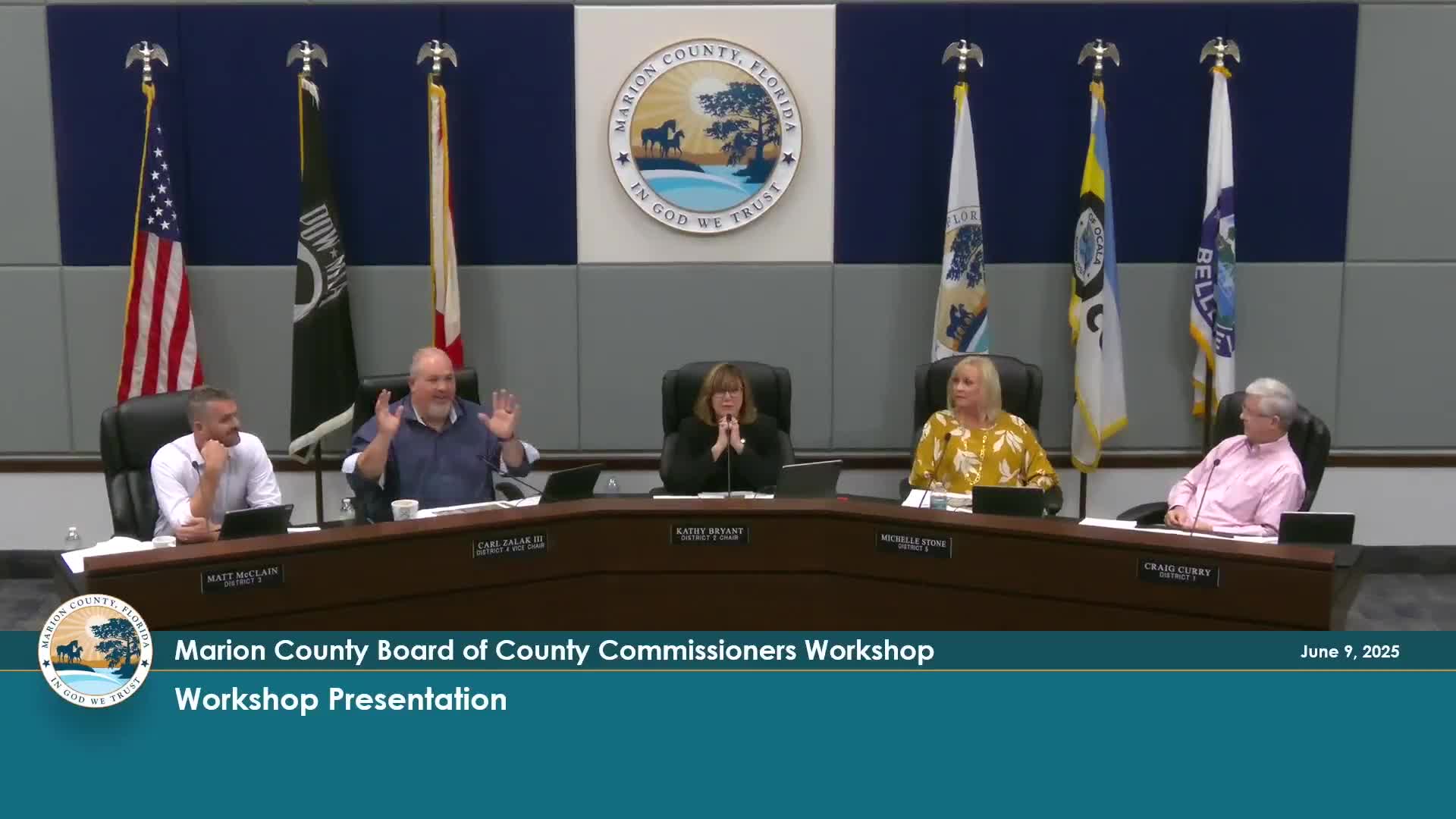
Marion County commissioners and planning staff discussed why small-acreage 'hamlet' or 1- to 5-acre residential options are rarely proposed despite apparent public demand, and what code, utility and maintenance constraints limit such development.
Planning staff explained that the county’s current hamlet provisions allow two density options, including 1 unit per 3.5 acres, but that option typically requires a water system capable of providing fire flow. A staff explanation noted that hamlets are not permitted in the county’s farmland preservation area, a restriction intended to protect larger agricultural operations.
Commissioners said property owners and prospective buyers want more 1–5 acre options for hobby farms and equine uses. “There are people that wanna have acre lots just for residential,” one commissioner said, and multiple commissioners urged the county to make it easier to create modest-acreage properties where appropriate. Staff cautioned developers often avoid constructing small-lot subdivisions because the cost of infrastructure—water systems, sewer connections or advanced septic systems—can be high and because utility connection distance standards or springs-protection rules may apply.
Planning staff pointed to existing examples such as Bel Lago and Hunterdon hamlets and said the county has authorized some hamlets historically, but uptake has been limited. Commissioners asked staff to prepare scenarios and examples so landowners and developers can see feasible pathways to create smaller-acreage residential lots without undermining agricultural protection zones.
AI generated
The text on this page is AI generated. Summaries, highlights, analysis, and video transcripts are all produced from the original source material.
AI can make mistakes, so if you spot one, and we will fix it for everyone.
Note: the source content is unaltered by us. Any content source we link to, be it a video, an audio recording, or a document, is presented exactly as its publisher released it. That publisher is usually a government body, sometimes an individual official or another organisation.